
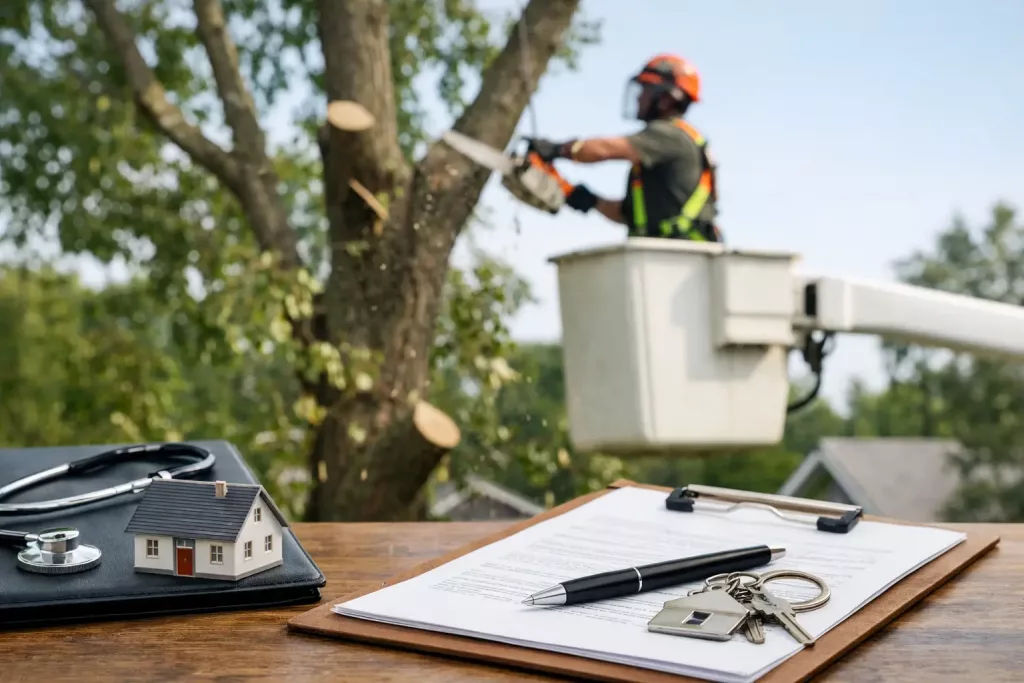
A healthy tree leaning over your roof is just a routine maintenance issue until a major storm snaps a branch and drives it through your shingles. Suddenly, you need emergency tree service and roof repairs. The real confusion usually starts with one simple question: is tree trimming covered by insurance? The short answer is that it depends entirely on how the damage happened and what your policy covers.
For homeowners and commercial property managers alike, the line between an out-of-pocket expense and an insurance claim can be blurry. Let’s break down when insurance policies generally cover tree work, when they definitely don’t, and how to navigate the process so you don’t end up paying for a covered loss out of pocket.
Table of Contents
- When tree trimming is covered by insurance
- When tree trimming is not covered by insurance
- Is tree trimming covered by insurance before storm season?
- What your policy language usually focuses on
- Document the issue before any work starts
- The difference between emergency work and preventive work
- Commercial properties and insurance expectations
- How to make the best insurance decision
When tree trimming is covered by insurance
Insurance is designed to cover sudden, accidental losses. Routine maintenance falls squarely on the homeowner. But if a storm, severe wind, or lightning damages a tree and it falls on a covered structure, insurance usually steps in.
The most common scenario is storm damage. If a hurricane or severe storm snaps a large branch and it damages your roof, the cost to remove the tree from the structure is typically covered as part of the claim. The key is that the tree must have damaged a covered structure—like the house, a detached garage, or a fence.
Another situation is when a tree falls and blocks a driveway or a handicap ramp. Even if it doesn’t damage a structure, the removal of the tree blocking essential access is sometimes covered. You will need to check your specific policy for this, as it varies by carrier.
In these covered situations, there is often a cap on how much the insurance will pay for the tree debris removal. Most policies cap debris removal between $500 and $1,000 per storm, no matter how many trees fall.
When tree trimming is not covered by insurance
This is where many property owners get frustrated. The vast majority of tree trimming and removal is not covered by insurance.
If a tree is simply overgrown, leaning heavily, or dropping leaves and small branches in the yard, that is a maintenance issue. Even if an arborist tells you the tree is dangerous and needs to come down, your insurance provider will almost certainly deny a claim for its removal. They view proactive maintenance as a homeowner’s responsibility.
The same goes for dead or dying trees. If a tree dies from disease, age, or insect infestation, removing it is an out-of-pocket expense. Your insurance expects you to handle these issues before the tree falls and causes damage.
If an overgrown or dead tree finally falls but doesn’t hit anything—it just lands in the middle of your yard—the cleanup is generally your responsibility. Unless it blocks a driveway or damages a covered structure, the insurance company will consider it yard debris.
Is tree trimming covered by insurance before storm season?
A lot of Florida property owners want to trim trees before hurricane season to reduce risk. That is smart property ownership. A well-pruned canopy allows wind to pass through smoothly and reduces the chance of major limb failure during a storm.
But will insurance pay for it? No. Insurance companies do not pay for preventive tree trimming. They view this as standard home maintenance, much like changing the oil in your car or replacing an aging roof before it leaks.
While your policy won’t pay for the pruning, failing to maintain your trees can sometimes impact your coverage. If a completely dead, rotting tree falls on your house and the insurance company determines it was due to gross negligence on your part, they could theoretically fight the claim.
What your policy language usually focuses on
The exact details of coverage are buried in your policy documents. There are a few key terms and concepts you should understand when reviewing your coverage.
Look for language around ‘covered perils.’ These are the specific events that trigger coverage, like windstorm, hail, fire, or lightning. If a tree falls because of a covered peril, you have a much better chance of coverage.
There is also a distinction between removing the tree from the structure and removing the debris from the property. Your policy might pay to lift the tree off your roof so the roof can be tarped, but limit the amount it pays to haul the chopped-up wood away.
If you are ever unsure, read your specific declarations page or call your insurance agent to ask hypothetical questions before a storm hits.
Document the issue before any work starts
If you believe you have a valid insurance claim, documentation is crucial.
Before anyone starts cutting, take clear photos of the damaged tree, the damaged structure, and the surrounding area. You need to prove that the tree fell due to a covered peril and that it caused damage. If a tree service chops everything up and hauls it away before the adjuster sees it, your claim could be denied.
Do not wait for the adjuster to arrive to secure the property. You have a responsibility to mitigate further damage. This means you can and should hire a professional tree service to safely remove the tree from the roof and place a tarp over the hole to prevent water intrusion. Just document everything first.
The difference between emergency work and preventive work
This distinction is at the heart of the insurance question.
Emergency tree work happens after a sudden loss. A tree is on your roof, water is pouring in, and the tree must be removed immediately to stop the damage and secure the home. This is the reactive work that insurance often covers.
Preventive work is about taking action before the storm. It is the careful pruning, canopy thinning, and hazard tree removal you do on a sunny day to protect your property. This is proactive work that is entirely your financial responsibility.
Commercial properties and insurance expectations
For commercial property owners and HOAs, the rules are generally similar, but the scale and liability are much larger.
Commercial policies often have different limits for debris removal and property damage. Additionally, commercial property managers face higher liability risks if a dangerous tree is left standing and injures someone or damages a tenant’s property.
For businesses and HOAs, budgeting for annual preventive tree care is not just a best practice; it is a vital risk management strategy.
How to make the best insurance decision
If you are dealing with storm damage, start with safety. Keep your family away from the area, and call a licensed tree service for an emergency assessment. They can safely stabilize the situation and often have experience working alongside insurance adjusters.
If you are looking at a leaning or overgrown tree on a sunny Tuesday, call a certified arborist for a maintenance quote. Don’t waste time trying to file a claim; the insurance company won’t cover it, and a denied claim can still go on your record.
The best way to handle tree-related insurance claims is to avoid them entirely. Invest in regular, professional tree trimming to keep your canopy healthy and your property safe when the next storm rolls in.