
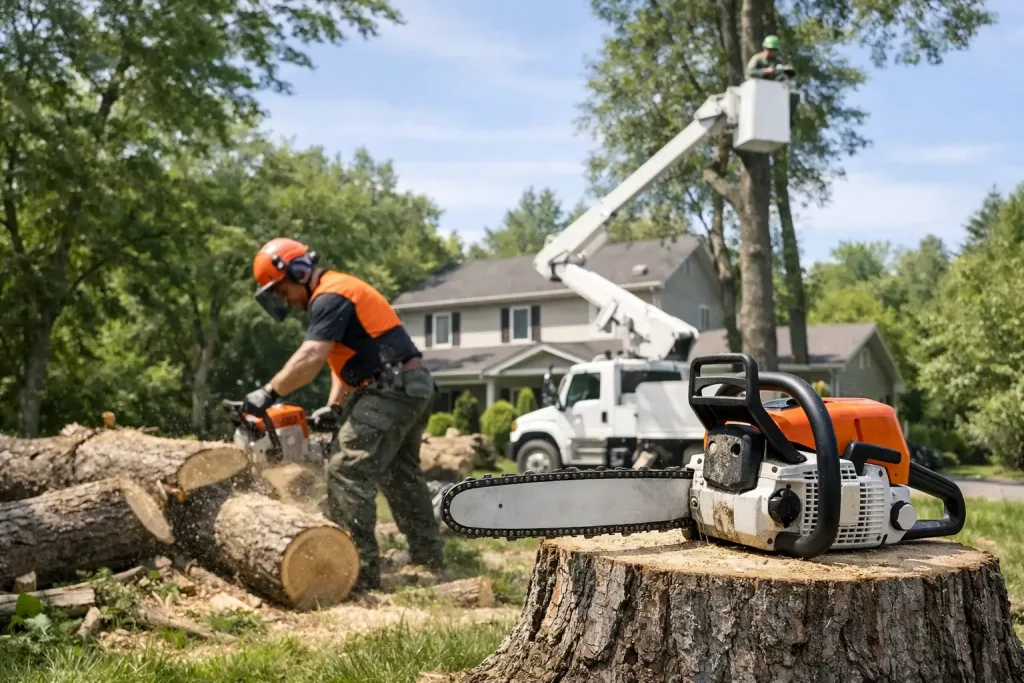
That leaning oak may have looked manageable six months ago. After one hard storm, though, the question changes from Should we deal with this later? to How do we handle it safely? This residential tree removal guide is built for property owners who need clear answers before a risky tree turns into a roof claim, blocked driveway, or emergency call.
Removing a tree from a residential property is rarely just about cutting wood. It involves safety, access, nearby structures, power lines, drainage, local rules, and the condition of the tree itself. In Central Florida, weather adds another layer. Saturated soil, high winds, and storm season can turn a weakened tree into a serious hazard fast.
When tree removal is the right call
Not every problem tree needs to come down. In many cases, pruning or structural correction can improve safety and appearance. But there are situations where removal is the responsible choice.
A dead tree is the clearest example. Once a tree has lost its structural integrity, limbs can fail without much warning, and the trunk may become unstable from the inside out. The same goes for trees with major trunk cracks, hollow sections, severe decay at the base, root failure, or a significant lean that appears recent.
Location matters just as much as condition. A tree growing too close to a house, over a garage, along a fence line, or near utility lines creates less margin for error. Even a living tree can become a removal candidate if its root system is lifting hardscape, affecting foundations, or making storm damage more likely.
Then there is the quality-of-life factor. Some homeowners put off removal because the tree is still partially green, even when it drops large limbs, shades out the roof to the point of moisture issues, or crowds the usable space around the home. If a tree creates ongoing risk or repeated damage, waiting usually costs more than acting early.
A residential tree removal guide to spotting risk early
Most dangerous trees do not announce themselves with one obvious sign. More often, several smaller warnings show up together.
Watch for dead limbs in the upper canopy, mushrooms or fungal growth near the root flare, bark that is falling away in large sections, and cracks where major limbs attach to the trunk. Soil heaving around the base can point to root plate movement, especially after heavy rain or wind. If a tree suddenly starts leaning more than it used to, that deserves immediate attention.
It also helps to think about targets. A tree in the back corner of a large lot may still be a concern, but a tree over a bedroom, driveway, pool enclosure, or neighboring property carries a much higher level of urgency. Risk is not just about whether a tree might fail. It is about what gets hit if it does.
For homeowners, the hardest part is often not knowing whether the tree is truly dangerous or simply overdue for maintenance. That is where a qualified inspection matters. A licensed and insured tree professional can assess structure, access, and removal complexity in a way that online photos and guesswork cannot.
Why DIY tree removal goes wrong
Residential tree work looks simpler from the ground than it actually is. A few cuts with a saw seems straightforward until the tree shifts weight, rolls, twists, or drops into the wrong direction.
The danger increases quickly when the tree is large, storm-damaged, decayed, or close to structures. Ropes, ladders, chainsaws, and gravity are a bad combination without training. Even experienced property owners often underestimate how much tension is stored in damaged limbs and how unpredictable a compromised trunk can be.
There is also the liability side. If a tree strikes a neighbor’s fence, damages a vehicle, or interferes with overhead lines, the cost of a do-it-yourself attempt can go far beyond the tree itself. Hiring a licensed and insured crew is not just about convenience. It is about controlling risk on a job where mistakes can be serious.
Permits, neighbors, and local rules
A good residential tree removal guide should address paperwork, because this is where homeowners get caught off guard. Some trees can be removed without much delay. Others may involve municipal rules, protected species considerations, lot restrictions, or documentation requirements.
The details depend on where the property is located and what kind of tree is involved. In parts of the Orlando area, local ordinances can affect whether a permit is needed, especially for larger trees or removals tied to development, lot clearing, or specific protected conditions. That is one reason local experience matters. A company that regularly works in the area is more likely to flag issues before the job starts.
Neighbors are another practical consideration. If a tree extends over a shared boundary or the work requires equipment access near adjacent property, communication helps prevent misunderstandings. You may not need your neighbor’s permission in every scenario, but you do need a plan that avoids damage and keeps the work zone controlled.
What affects the cost of tree removal
Homeowners often ask for a price per tree, but tree removal does not work like buying a standard item off a shelf. The cost depends on the tree and the site.
Height and diameter are obvious factors, but they are only part of the picture. A medium-sized tree in an open yard may be simpler to remove than a smaller tree wedged between a house, screen enclosure, and overhead service line. Accessibility, rigging requirements, crane use, condition of the wood, storm damage, and cleanup scope all influence pricing.
Emergency timing can also affect cost. A tree that is already on a structure or hanging dangerously after a storm usually requires a more urgent, controlled response. That kind of work is different from scheduled removal on a dry, stable site.
The lowest quote is not always the best value. If a bid seems unusually cheap, ask what is included, whether the company is licensed and insured, and how they plan to protect structures, driveways, fencing, and surrounding trees. A clear written estimate should match the complexity of the job.
What to expect from a professional removal crew
A reputable crew starts with an assessment, not a chainsaw. They look at the tree’s condition, identify hazards, confirm access points, and decide whether the removal will be done in sections or in a more direct drop if space allows.
On most residential jobs, controlled dismantling is the safer method. Limbs are removed in stages, larger sections are rigged and lowered, and the trunk is cut down piece by piece. This approach takes more planning, but it protects the home, nearby features, and the crew.
You should also expect safety protocols. That includes traffic through the work area being restricted, proper equipment use, and a plan for debris handling. If the tree is near utility lines, extra caution is required, and the work may need coordination depending on the situation.
For homeowners, communication is a good sign of professionalism. You should know what is being removed, how access will work, what the crew needs from you before arrival, and what the property will look like when the job is done. Companies with long local experience, like Tree Amigos Orlando, understand that homeowners are not just paying for labor. They are paying for confidence that the job will be handled the right way.
Preparing your property before removal day
A little preparation makes the job smoother and safer. Move vehicles out of the driveway and away from the work zone. Clear patio furniture, potted plants, and other movable items that could be affected by falling debris or equipment traffic.
If you have pets or young children, plan to keep them well away from the area during the work. It is also smart to let household members know there will be noise, restricted access, and crew activity for part of the day.
If access is tight, the crew may need to use gates, side yards, or specific entry points. Confirm those details in advance. The more open and organized the site is, the more efficiently the work can be completed.
After the tree is gone
Once a problem tree is removed, many homeowners notice something immediately: relief. The constant worry during every thunderstorm is gone. So is the overhanging risk to the roof, driveway, or neighboring property.
That said, tree removal can change the feel of a yard. More sunlight, different drainage patterns, and a wider view are common. Sometimes that is a major improvement. Other times, homeowners realize they want a plan for shade, privacy, or future tree placement. That is worth thinking through before removing multiple trees at once.
If the tree came down because of disease, decline, or storm damage, it is also a good time to look at the rest of the property. Trees often respond to the same site conditions, and a close look at nearby specimens may help prevent the next problem before it becomes urgent.
A smart homeowner does not wait for a tree to fail before taking it seriously. If something looks off, leaning, cracked, dead, or simply too close for comfort, trust that instinct and get it evaluated. The best time to handle a hazardous tree is usually before the next storm gives you no choice.