
- FAQ & Tree Advice, Orlando Tree Services, Tree Removal & Regulations
Downtown Orlando Tree Removal: Navigating Historic District Grand Tree & Permit Requirements
Providing professional tree trimming and removal in Orlando, Florida, and surrounding areas.
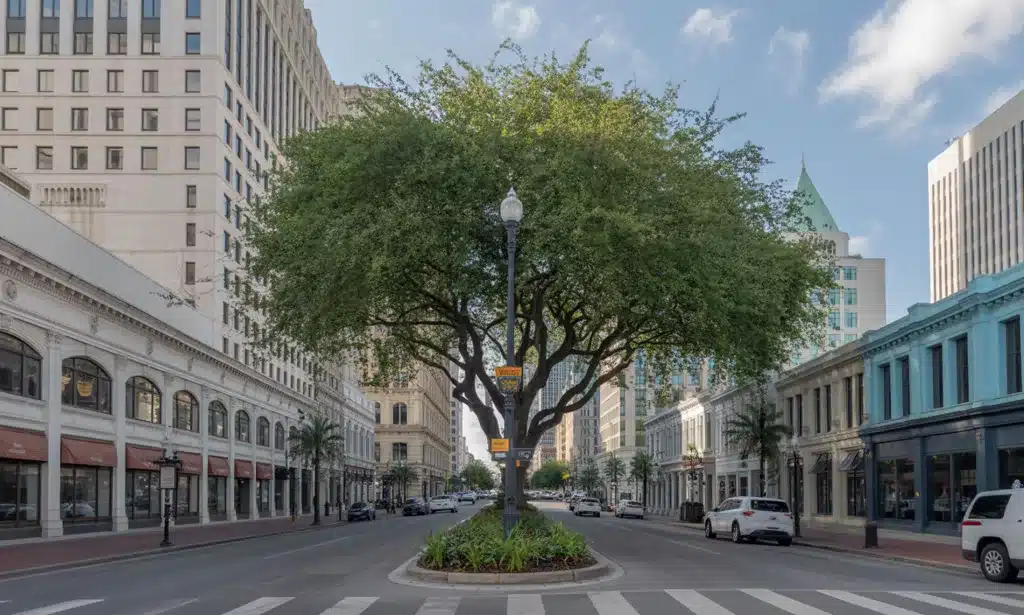
The Certified Arborist’s Guide to Compliance in Lake Eola, Eola Heights, and Delaney Park
For property owners in the heart of the City Beautiful—especially within the historic, tree-dense neighborhoods like Lake Eola Heights, Delaney Park, and Colonialtown—tree removal is not just a landscaping decision; it is a complex, regulatory process. The City of Orlando is intensely focused on preserving its urban canopy, and its ordinances are among the strictest in Central Florida.
Attempting a tree removal, even on your own property, without following the exact protocol can result in fines reaching $15,000 per violation, especially when a protected Grand Tree or Historic Tree is involved.
As ISA Certified Arborists operating in Downtown Orlando for decades, Tree Amigos Orlando has developed the definitive, compliant checklist to safely and legally manage your protected trees. We handle the entire process—from the initial risk assessment to the final permit application with the Orlando City Planning Division.
1. Defining the Protected Tree: Is Your Tree a “Grand Tree”?
Before any removal discussion begins, the first, most crucial step in Downtown Orlando is to determine if your tree falls under the City’s protective ordinances.
The Protected Tree Standard
In the City of Orlando, a Protected Tree is defined as any existing tree with a Diameter at Breast Height (DBH) of 6 inches or larger, measured 4.5 feet above the ground. While this is the minimum standard, the most stringent rules apply to a subclass: the Grand Tree.
| Protected Tree Classification | Criteria | Common Species in Downtown Orlando |
|---|---|---|
| Grand Tree | Healthy trees meeting a specific size threshold (often 24″ DBH for Live Oaks). | Live Oak, Southern Magnolia, Bald Cypress |
| Historic/Specimen Tree | Designated by the Parks Official or City Council for cultural significance, regardless of size. | Trees in Lake Eola Park, Eola Heights landmarks. |
| Regulated Tree | Any tree 6″ DBH or larger not classified as a Grand/Historic Tree. | Maple, Pine, smaller Oak varieties. |
The fines for illegally removing a protected tree—particularly a Grand or Historic tree—are extremely steep, often calculated based on the caliper inches of the lost tree and the required mitigation costs.
2. Navigating the Permit Process: Residential vs. Commercial
The permit pathway for tree removal is dictated by the property type and the tree’s health. In high-density Downtown areas, navigating the City of Orlando Tree Removal Permit is mandatory for almost all non-exempt trees.
A. The Hazardous Tree Exemption (The Fastest Path)
Thanks to Florida Statute 163.045, an Orlando property owner may remove a tree on residential property without a City permit if a certified professional confirms the tree poses an “unacceptable risk.” This is the most common path for urgent or emergency situations.
To qualify for this exemption, documentation from a Certified Arborist is Non-Negotiable.
Your Tree Amigos Orlando arborist must formally declare, with a detailed report, that the protected tree is either:
- Dead: Showing clear signs of mortality (e.g., lack of green cambium, no leaf-out).
- Severely Diseased: Suffering from an untreatable local disease (e.g., advanced Ganoderma Root Rot).
- An Unacceptable Risk: Structurally failing (e.g., major trunk crack, severe lean with root heave, internal decay verified by resistance drilling).
Crucial Step: We must secure and retain a copy of the Certified Arborist’s Report and the Hazardous Tree Removal Affidavit before the removal crew starts work. This burden of proof rests entirely on the property owner and is the only defense against future code enforcement action. (For more details on this process, see our guide on the Hazardous Tree Removal Orlando: Grand Tree Exemption Checklist).
B. The Standard Permit Process (For Healthy/Non-Hazardous Trees)
If the tree is healthy, you must apply for a permit directly through the City of Orlando.
- Initial Application: Submit the application to the City’s Planning Division, including the required residential fee of $25 or the commercial fee of $50 per acre.
- Required Documentation: You must include a site plan and photographs of the tree.
- City Arborist Inspection: A City arborist will inspect the tree within three business days to verify its status and the justification for removal.
- Mitigation: If approved, the City will require a mitigation plan, usually requiring you to plant a specific number of replacement trees (or pay an equivalent fee) to offset the canopy loss. For commercial projects, this mitigation is significantly more rigorous.
3. Historic Districts: The Layer of Complexity
For properties in Downtown Orlando’s officially designated Historic Districts (such as Lake Eola Heights or Eola Park), an additional layer of review is mandatory, regardless of the tree’s protected status.
The Certificate of Appropriateness (COA)
Any exterior alteration to a property within a Historic District—which includes major landscape changes like tree removal—often requires a Certificate of Appropriateness (COA). This means your removal request is reviewed not just by the City Arborist, but also by the Historic Preservation Board to ensure the removal does not detract from the district’s character.
- Impact: This review adds time to the permit process.
- Expertise Required: We coordinate documentation to demonstrate that removal is either an urgent safety issue or that the tree is incompatible with the historic structure (e.g., causing root damage to the historic foundation or sidewalk, which is a high-value search we address in our other content).
4. The Tree Amigos Orlando Difference: Your Compliance Partner
Navigating the local ordinances is the single biggest barrier to entry for unlicensed or inexperienced tree services. In a historic, dense urban environment like Downtown Orlando, the risk is too high to trust anyone but a certified expert.
Tree Amigos Orlando provides:
- ISA Certified Arborist Reports: Our arborists carry the necessary TRAQ (Tree Risk Assessment Qualification) to provide the legally required documentation for the Florida Statute 163.045 exemption.
- Complete Paperwork Management: We handle the entire application process, including submitting your plans to the Orlando Parks Division and coordinating the City’s inspection.
- Precision Removal in Confined Spaces: Downtown properties are often tightly spaced. We utilize advanced rigging and sectional removal techniques to ensure zero-damage removal, even for the largest Live Oaks overhanging historic homes.
Why E-A-T (Expertise, Authority, Trust) Matters Downtown
Google values the most authoritative and trustworthy source, especially for complex, high-risk topics. By referencing and linking to official City sources, we establish that authority:
- Official Authority Link: For general information on the city’s tree initiatives and ordinances, always refer to the official City of Orlando Tree Request, Reporting & Removal page.
- Legislation Context: For context on why these laws exist, we recommend reviewing the ongoing efforts by Orange County Government to protect its canopy (which heavily influences City codes).
Final Takeaway for Downtown Homeowners
Do not guess. Do not assume. The penalty for non-compliance is almost always more expensive than the removal service itself. For any protected tree in Lake Eola Heights, Delaney Park, or any other Downtown neighborhood, the first call must be to an arborist who is an expert in Orlando’s City Code.
The Downtown Orlando canopy is a valuable asset—let us help you manage it legally and safely.
Posted on Google
 Jasper
Trustindex verifies that the original source of the review is Google.
First this tree is completely on my neighbor's side these guys did a great job at clearing the overgrowth over my property and over my house quite a job this was a high up reach and completely cleared my airspace from the overgrowth of the tree, it was a danger to walk into my backyard as tree was getting old and big branches were falling some widowmakers were there you know what I mean( I feel safe going into my yard now) Three amigos you guys did an exceptional job thank you so much.Posted on Google Michael BrauchNick and the crew at Tree Amigos were fantastic. Great pricing, timing, crew, etc. We had a 50-60ft tree in our backyard that needed to be removed and other large trees to be trimmed. They were able to get us on the schedule quickly and left the yard in great condition. Highly recommend!Posted on Google
 juan canoBest price in town, great service, great consideration of neighbors during removal of huge oak treesPosted on Google
 Ryan JepsonThese guys killed it. I had an annoying, big, complicated landscape removal project. Huge trees to remove, overgrown jungle to remove, dozens of stumps to grind. They had a fair price and did a great job. Super happy with the outcome.Posted on Google
 Alton CumberbatchNick, from Tree Amigos Orlando, came by and discussed my trimming needs. His quick scheduling and execution improved the presentation of my front yard immeasurably. Nick, please accept my appreciation for your superior work. Thanks a bunch:to you and your crew! Alton.Posted on Google
 Liliana TaylorVery quick turnaround from quote to service and did a very thorough job cleaning up after!Posted on Google
 Kevin HallI did not have work done by this company, but my neighbor did and I can tell you they did an exceptional job. Not only were they fast and efficient. They took the courtesy of getting any debris out of my yard as well, which is unheard of nowadays. The guys were very friendly and I would definitely recommend them.Posted on Google
 BIG MAFriendly and courteous! Completed two large tree removals in great time. Total clean up of area. 😎😅Posted on Google
 Barb AllenGood price for two tree removal. Friendly workers. Total clean up of area.Posted on Google
 Manuel Rodrigues100% recommend Tree Amigos! They did a great job trimming all the trees around my house. They definitely know what they’re doing. Fair price, showed up on time, very respectful, and left everything clean. A good old school company that does quality work at a reasonable price. Great experience and I’ll definitely use them again!Load more