
- FAQ & Tree Advice, Tree Removal & Regulations
The Homeowner’s Guide to Dealing with Neighbors' Trees: Orlando Property Line Rules for Trimming and Removal
Providing professional tree trimming and removal in Orlando, Florida, and surrounding areas.
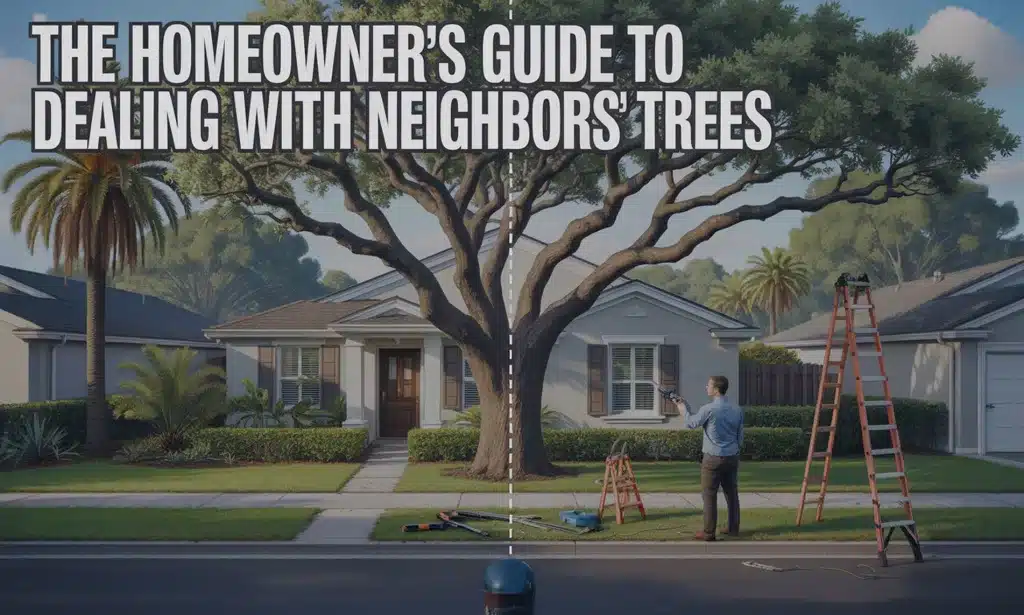
Table of Contents:
Important Disclaimer: This article provides informational guidance based on common Florida statutes and local ordinances. It is not a substitute for legal advice. If you are involved in a tree dispute or litigation, please consult a qualified attorney.
Introduction: The Tangle of Trees and Torts in Central Florida
It’s one of the most common and uncomfortable disputes in the Sunshine State: your neighbor’s beautiful, mature Live Oak has decided that your driveway is the perfect place to drop its branches, or worse, its root system is buckling your sidewalk. When a tree straddles the invisible line between two properties, the question of who is responsible for trimming, maintenance, damage, and ultimately, removal can quickly turn friendly neighbors into bitter adversaries.
As your local experts with decades of experience navigating these exact scenarios across Orlando, Winter Park, and Central Florida, we’re here to cut through the confusion.
This comprehensive guide is designed to empower Orlando homeowners with the factual, legal, and practical knowledge you need to manage your boundary-line tree issues responsibly, legally, and in a way that protects your property value—and hopefully, your relationship with your neighbor.
Part 1: The Foundation of Florida Tree Law—The “Self-Help” Rule
The most critical principle governing neighbor-on-neighbor tree issues in Florida is the “self-help” rule. This principle, established over decades of state case law, is the starting point for nearly every residential tree dispute.
The rule is simple and applies exclusively to branches and roots:
A property owner has the legal right to trim or cut back any encroaching branches or roots up to the boundary line of their property. You may not cross the property line to perform work, and you may not do anything that will kill or permanently damage the entire tree.
This means if a branch from your neighbor’s mighty Laurel Oak is hanging ten feet over your roof, you have the right to trim that branch back to the property line, even if it is a major inconvenience to you and your neighbor.
Critical Limitation: The “Reasonable and Necessary” Standard
While you have the right to trim, that right is not absolute. Florida courts generally uphold that the trimming must be “reasonable and necessary.” Critically, if you cut the branch in a way that is structurally unsound, permanently deforms the tree, or causes it to die, you can be held liable for damages—which can be substantial, especially if it’s a protected, mature tree.
This is why, as local tree care experts, we cannot stress this point enough: Do not attempt to perform significant trimming yourself or hire an unlicensed contractor. The legal and financial risk of harming a neighbor’s tree far outweighs the cost of a professional arborist.
Internal Link Opportunity: If you need professional, insured trimming services that respect property lines and the health of the tree, consult our Orlando Tree Trimming Services page today.
Part 2: Where the Rules Change—Who Pays for Damage and Debris?
The self-help rule determines who can trim, but it doesn’t always settle the score on mess or payment. This is where most homeowners get frustrated.
1. Who Pays for Trimming?
You do. Since the self-help rule grants you the right to trim the encroaching portions, the cost of that trimming is generally your responsibility. The law considers the encroachment a nuisance that you have the right to abate (fix) at your own expense.
2. Who is Responsible for the Debris?
You are. If you hire a service to trim the branches, you are responsible for the debris on your side. You cannot simply throw the trimmings back into your neighbor’s yard—that constitutes trespassing or illegal dumping.
3. When Does the Neighbor Become Financially Liable? (A High Bar)
A neighbor is only responsible for the cost of trimming or removal if the tree is deemed legally “negligent.” This is a difficult standard to meet in Florida. The tree must have been:
- Diseased, dead, or visibly decaying (a known hazard).
- The neighbor knew or reasonably should have known it was a hazard.
- The neighbor failed to act to correct the hazard.
If a healthy tree falls due to a lightning strike or a sudden, severe hurricane, it is considered an “Act of God.” In this common Orlando scenario, the homeowner whose property the tree lands on is generally responsible for the removal and the insurance claim.
Internal Link Opportunity: For hazardous or storm-damaged trees that require immediate attention, contact us immediately for Emergency Tree Services. We specialize in swift, safe, and insured hazardous tree removal.
Part 3: The Orlando Complication—Protected and Grand Trees
In a place like Central Florida, the statewide “self-help” rule is often complicated by local ordinances, especially for trees that fall under city or county protection.
Both the City of Orlando and Orange County have specific regulations regarding “Grand Trees” (often large, historic oaks, magnolias, etc.) and native species.
Key Regulatory Point (The Permit Trap)
If the neighbor’s encroaching tree is a protected or Grand Tree, you cannot simply trim it aggressively back to the property line. You risk a steep fine if your trimming constitutes “mutilation” or threatens the survival of a protected specimen.
Example: If trimming a Grand Oak branch back to your property line requires removing more than 25% of the tree’s canopy (a common local rule for protected trees), you could be penalized.
The Expert Solution: When dealing with a large, protected tree near the boundary, the first step is always to hire an ISA Certified Arborist (like those at Tree Amigos Orlando). An arborist can:
- Verify the tree’s protected status with the city/county.
- Determine the safest, healthiest amount of trimming possible.
- Provide the necessary documentation for potential permits, which may shift the conversation toward a cooperative effort with the neighbor.
Citation Opportunity: Cite or reference Orange County Land Development Code (LDC) regarding protected trees, or City of Orlando regulations regarding the removal permit process.
Part 4: A Step-by-Step Action Plan for Orlando Homeowners
Before you pick up the phone to hire a crew (or send an angry text to your neighbor), follow this professional checklist.
Step 1: Document the Problem (The Evidence)
Take clear, dated photographs of the encroachment, any structural damage (cracked pavement, roof damage), and, if possible, the condition of the tree (rotting, fungal growth). Documentation is your most powerful tool if the dispute escalates.
Step 2: Consult a Certified Arborist (The Authority)
A professional assessment is non-negotiable, especially for large or protected trees. The arborist will determine:
- The health and structure of the tree.
- The potential solutions (e.g., proper crown reduction versus full removal).
- If the tree meets the legal standard of “hazardous” or “negligent.”
An arborist’s report can transform an emotional dispute into a factual, expert-driven conversation.
Step 3: Initiate Communication (The Olive Branch)
Present your neighbor with the arborist’s findings first and suggest a collaborative solution. A common scenario is proposing to split the cost of professional trimming to ensure the tree remains healthy and beautiful for both parties. Always communicate in a polite, documented manner (e.g., certified letter or email).
Step 4: Act Within the Law (The Action)
If the neighbor is unresponsive or refuses cooperation:
- Trimming: Proceed with professional trimming up to the property line, ensuring the work is performed by a licensed, insured company that guarantees the health of the remaining tree structure.
- Removal: If the arborist certifies the tree is an immediate hazard, you may need to file a formal complaint with the City of Orlando or Orange County, or consult an attorney. You cannot unilaterally remove a healthy tree on their property.
Internal Link Opportunity: If the situation is beyond trimming and requires a complete solution, learn about the full, safe process on our Professional Tree Removal service page.
Conclusion: Expertise Mitigates Risk
Dealing with neighbor-related tree issues is often about managing risk. The risk of property damage, the risk of violating local ordinances, and the risk of litigation.
As Orlando’s trusted local tree service, Tree Amigos Orlando operates with full liability insurance, ISA Certified Arborists, and deep knowledge of all local codes—from Grand Tree exemptions to proper pruning techniques. Our goal is to provide a stress-free solution that protects your property, respects your neighbor’s rights, and ensures the beautiful health of the Central Florida tree canopy.
Don’t let a tree on the property line become a legal or financial burden.
Call Tree Amigos Orlando today for an expert consultation and a free, no-obligation estimate to resolve your property line tree issues safely and legally.
Posted onTrustindex verifies that the original source of the review is Google. I have used Tree Amigos two times. They gave me a quote and came quickly to do the job. They were very professional and kind and did superb work! I would definitely recommend them and will use them again for tree trimming maintenance.Posted onTrustindex verifies that the original source of the review is Google. I have used them in the past, they lived up to my previous experience with them. Easy to work with and very efficient. Will definitely use them again in the future.Posted onTrustindex verifies that the original source of the review is Google. We had 4 tall pine trees removed by the Tree Amigos team led by Luis and they performed over and above what was promised. Highly recommended especially for difficult tree removal jobs.Posted onTrustindex verifies that the original source of the review is Google. Luis and his crew did a great job. I’m very pleased.Posted onTrustindex verifies that the original source of the review is Google. I have used Tree Amigos many times and always had a positive experience. Recently had a huge tree taken down in my backyard and couldn’t be more pleased with their work!Posted onTrustindex verifies that the original source of the review is Google. Tree Amigos is always fast and very fair priced.Posted onTrustindex verifies that the original source of the review is Google. Luis was super responsive and provided a fair price. They were able to grind two stumps by the next business day and were understanding of the needs on site.Posted onTrustindex verifies that the original source of the review is Google. I have had Tree Amigos help with tree trimming and sod replacement. Great team with great service.Load more