A tree can look “mostly fine” right up until a large limb drops, the canopy thins out, or the trunk starts splitting under stress. That is why knowing how to identify tree disease matters far more than appearance. It is a safety issue, a property-value issue, and in many cases, the difference between a tree that can be treated and one that cannot.
For homeowners and property managers, the challenge is that tree disease rarely announces itself with one obvious symptom. You usually see a pattern instead. Leaves change color out of season. Bark starts peeling in odd sections. Mushrooms appear at the base. One side of the canopy dies back while the rest tries to keep growing. When several of these signs show up together, it is time to take a closer look.
Table of Contents
- How to Identify Tree Disease Without Guessing
- Common Signs of Tree Disease
- Tree Disease or Something Else?
- When a Diseased Tree Becomes a Hazard
- What You Can Check Safely and What You Should Not
- When to Call a Professional for Tree Disease
How to Identify Tree Disease Without Guessing
The safest way to inspect a tree is to work from the outside in. Start with the full silhouette of the tree from a distance, then move closer to inspect leaves, branches, bark, root flare, and the ground around the trunk. This helps you spot patterns instead of focusing too quickly on one symptom that may have a harmless explanation.
Begin with the canopy. A healthy tree usually has a consistent shape for its species and season. If the crown looks thin, uneven, or sparse on one side, that can point to stress, root damage, insect activity, or disease. Dead branch tips, bare sections during the growing season, and leaves that are much smaller than normal also deserve attention.
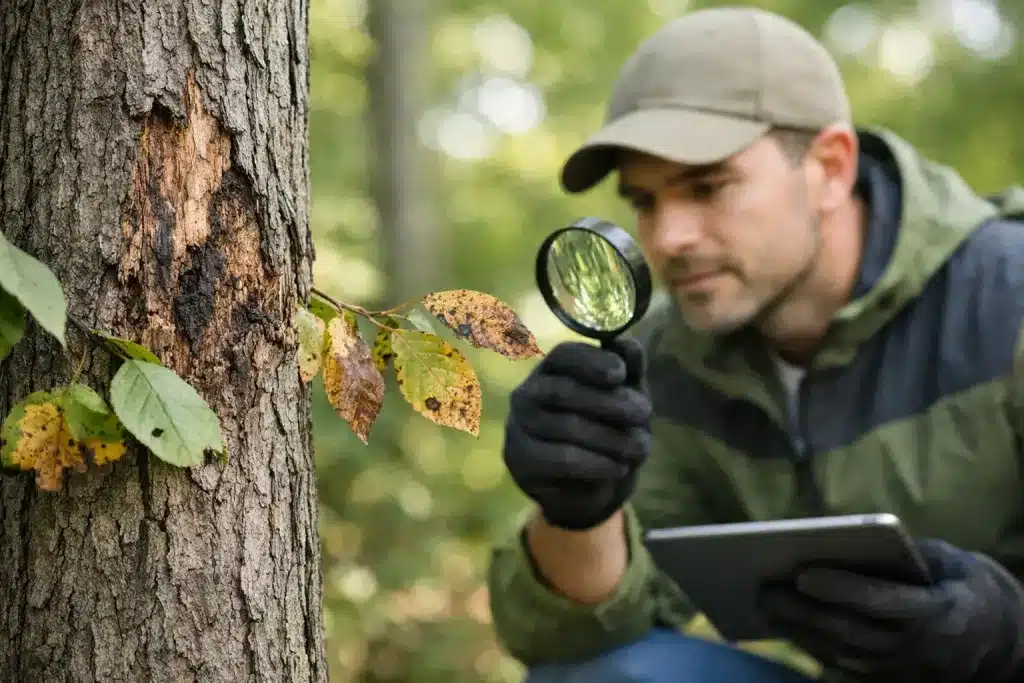
Next, look at the leaves or needles. Discoloration is one of the first visible warnings, but it is not always straightforward. Yellowing can come from poor drainage, drought stress, nutrient issues, or root problems. Brown edges may reflect heat stress, salt exposure, or infection. Black spots, powdery coatings, curled growth, and early leaf drop lean more strongly toward disease. The key is whether the problem appears widespread, moves unseasonably fast, or affects only one tree while nearby plants look normal.
Branches tell their own story. Cankers, sunken areas, cracked wood, and white dead limbs can all signal disease progression. If a branch dies suddenly while the rest of the tree remains green, that may be a localized issue. If many limbs die back over time, especially from the top down, the problem is often more serious.
Then inspect the trunk and bark. Peeling bark varies by species, so rough bark alone is not a problem. What you are looking for is change. Bark that is peeling away in patches, oozing sap, splitting vertically, or exposing soft wood underneath may indicate infection or decay. Cavities, fungal growth, and hollow sounds when tapped (which can also point to insects) all warrant a closer look.
Do not ignore the base of the tree. Root flare should be visible, not buried too deeply under soil or mulch. Mushrooms, conks, soft spots, and cracked soil around the base can indicate root rot or decay below ground. In Central Florida, where heavy rains, heat, and storm stress often work together, root-related issues can escalate fast.
Common Signs of Tree Disease
If you want a practical answer on how to identify tree disease, focus on symptoms that appear in groups. One bad leaf is rarely a crisis. Several warning signs across different parts of the tree usually are.
Leaf and needle symptoms
Watch for spotting, blotches, mildew, sudden curling, and off-season color change. Premature leaf drop is another red flag, especially if the tree should still be in active growth. On evergreens, needle browning from the inside out can be normal in small amounts, but widespread browning or rapid needle loss is not.
Bark and trunk symptoms
Cankers are among the more serious signs because they often indicate dead tissue on the bark or branch. Oozing sap, dark streaks, deep cracks, and bark sloughing off in sections should also be taken seriously. If the trunk shows multiple wounds and the canopy is declining, disease and structural weakness may be developing at the same time.
Root-zone symptoms
Root problems are easy to miss because most of the damage happens underground. Still, the top of the roots show above ground. Leaning, slow growth, thinning foliage, and dieback after heavy rain or irrigation problems can all suggest root stress. Fungal growth at the base is especially concerning because it may point to internal decay.
Whole-tree decline
Sometimes the strongest clue is general decline with no single obvious cause. A tree that does not leaf out fully, drops limbs more often, or looks weaker each season may be dealing with disease, pests, compaction, poor drainage, or a combination of issues. That is why diagnosis should rarely rely on one symptom alone.
Tree Disease or Something Else?
This is where property owners often get tripped up. Not every unhealthy-looking tree has a disease. Heat stress, overwatering, string trimmer damage, mower injury, poor pruning, construction impact, and insects can all mimic disease symptoms.
For example, yellow leaves may come from root rot, but they may also come from soil that stays too wet. Cracked bark may result from disease, or it may stem from storm damage and sunscald. A sparse canopy might mean infection, or it might mean the tree was pruned incorrectly last season.
The trade-off is simple: if you assume it is disease and start treating the wrong problem, you waste time while the tree declines. If you assume it is minor stress and ignore it, you may miss the early treatment window. When symptoms are spreading, affecting large limbs, or showing up near the trunk or root zone, professional evaluation is the smart move.
When a Diseased Tree Becomes a Hazard
Disease is not just a health issue; it can turn into a liability issue. As decay spreads, wood strength drops. Limbs become brittle. Trunks lose load-bearing capacity. Root systems weaken and stop anchoring the tree properly.
That risk increases during Florida storm season. A tree with internal decay or advanced dieback may still be standing on a calm day, then fail under wind and saturated soil. If the tree is near a house, driveway, parking area, sidewalk, or commercial structure, delayed action can get expensive fast.
A few conditions deserve immediate attention: large dead limbs over targets, visible fungal conks on the trunk, sudden leaning, deep trunk cracks, hollow sections, and major canopy dieback. These signs do not always mean removal is the only option, but they do mean the tree needs prompt inspection.
What You Can Check Safely and What You Should Not
You can do a basic visual inspection from the ground. Look at the canopy from different angles. Check for leaf changes, branch dieback, bark damage, mushrooms at the base, and exposed roots. Take photos over time if you are unsure whether the condition is getting worse.
What you should not do is climb the tree, cut large limbs to “test” them, or strike the trunk aggressively to check for hollowness. You also should not assume store-bought treatments will solve the issue. Tree disease management depends on the actual cause: the species, the extent of spread, and the tree’s location on the property.
In some cases, pruning infected limbs early can help. In others, cutting at the wrong time can spread pathogens or create new stress. That is why diagnosis comes first.
When to Call a Professional for Tree Disease
If you are wondering how to identify tree disease well enough to protect your property, the honest answer is this: you can spot warning signs, but you cannot always confirm the cause on sight. A licensed tree care professional can assess whether the issue is fungal, bacterial, environmental, insect-related, or structural.
That matters because the next step depends on the diagnosis. One tree may need selective pruning and monitoring. Another may need immediate removal because the trunk is compromised. Another may recover with corrective care if caught early enough. It depends on the species, age, location, and level of decline.
For owners in Orlando and nearby communities, local experience matters too. Weather patterns, soil conditions, drainage issues, and storm exposure all affect how tree problems show up in the field. A dependable, insured crew will not just point at dead leaves and guess. They will look at the full site picture, including the health of the tree, the safety of the site, and the best path forward.
Tree Amigos Orlando has spent more than 25 years helping property owners recognize when a tree can be saved and when it has become a hazard. If something about a tree on your property looks off, trust that instinct early. A check inspection now is a lot easier than dealing with a failed tree later.
The best time to act is usually the moment a tree stops looking like itself.