A low-hanging limb over a customer walkway, a declining oak near a loading area, or storm-damaged debris at an entrance can quickly become more than a maintenance issue. Commercial tree care helps property owners and managers prevent those disruptions before they affect safety, operations, curb appeal, or liability.
For Central Florida businesses, trees add shade and character, but they also face intense sun, heavy rain, high winds, pests, and compacted soils around parking areas and buildings. A dependable care plan is not about making every tree look perfectly uniform. It is about identifying risk, protecting healthy trees, and handling necessary work with insured crews, proper equipment, and respect for the people using the property.
Why Commercial Tree Care Requires a Different Approach
Commercial properties have more moving parts than a typical residential yard. There may be employees arriving before sunrise, customers using walkways throughout the day, delivery vehicles backing into service areas, tenants with shared access, and strict expectations from ownership groups or insurers. Tree work has to fit around those realities.
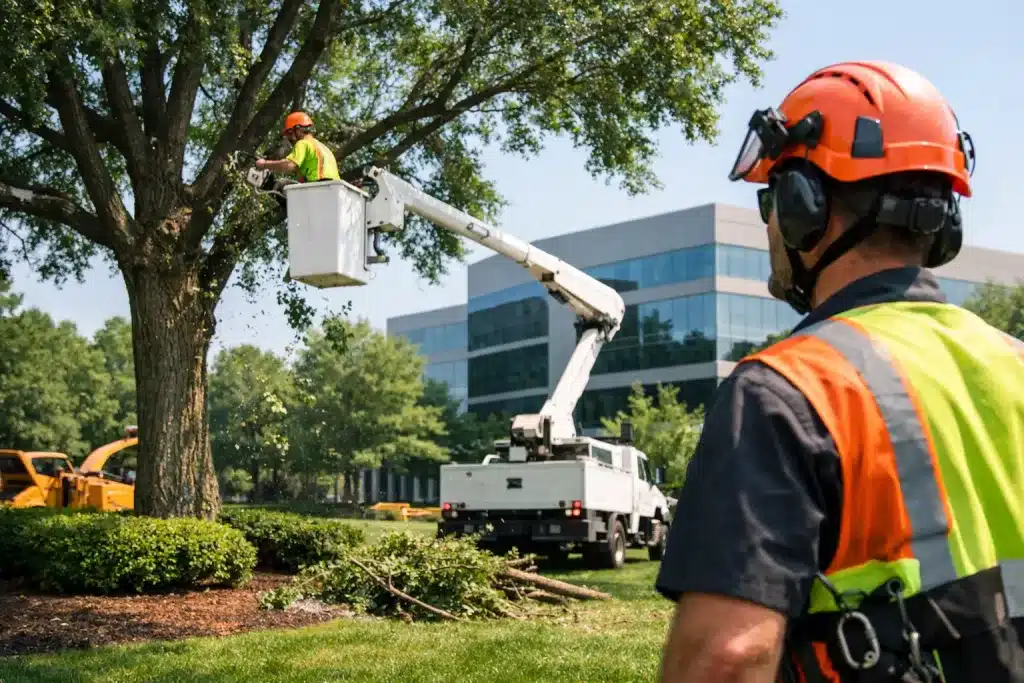
A well-planned service visit starts with the site, not just the tree. Crews need to assess vehicle traffic, pedestrian routes, overhead utilities, structures, drainage areas, fencing, and work zones. On a retail center, that may mean scheduling work before peak customer hours. At an apartment community, it may mean giving residents clear notice before work begins. At an office or medical facility, it may mean controlling noise and maintaining a safe perimeter around the work area.
The right scope also depends on the property’s goals. A managed community may prioritize clearance over sidewalks and lighting. A warehouse may need branches kept away from truck routes and rooflines. A commercial lot preparing for expansion may need selective tree removal and site-ready clearing performed safely. One-size-fits-all recommendations are rarely the best answer.
What a Commercial Tree Inspection Should Identify
Routine inspections are the foundation of practical tree care. They give property managers a clear record of visible concerns and help them plan work before an issue becomes urgent. Inspections are especially useful before hurricane season, after major storms, during property acquisitions, and ahead of construction or exterior renovations.
A qualified crew looks beyond whether a tree appears green from a distance. The condition of the trunk, roots, branch structure, canopy, and surrounding ground all matter. Cracks, cavities, deadwood, fungal growth, leaning, soil movement, hanging limbs, and branches rubbing against structures can point to increased risk. Not every defect means a tree must come down, but every concern deserves an informed evaluation.
Inspection findings should lead to clear, usable recommendations. Property decision-makers need to know which work is urgent, which work should be scheduled soon, and which items can be monitored. That distinction matters when maintaining multiple properties or working within an annual maintenance budget. Spending first on a hazardous limb above a busy entrance is more responsible than focusing only on cosmetic trimming elsewhere on the site.
Commercial Tree Care Priorities for Safer Sites
The highest-value work often centers on clearance, structural health, and hazard reduction. Proper pruning can remove dead or broken branches, reduce interference with buildings, improve clearance above drive lanes, and lessen excess weight in select sections of a canopy. It should be performed with a purpose, not as indiscriminate cutting.
Poor trimming practices can create problems that outlast the initial job. Cutting too much live growth at once can stress a tree, encourage weak regrowth, and leave it more vulnerable to heat and storm damage. Topping, which removes large portions of a tree’s upper canopy, is particularly damaging and can lead to weakly attached shoots. It may produce a shorter-looking tree for a time, but it does not create a safer or healthier long-term result.
On commercial sites, priorities commonly include the following:
- Removing dead, broken, or hanging branches near occupied areas.
- Creating appropriate clearance from roofs, signs, lighting, and drive lanes.
- Addressing limbs that interfere with service access or emergency routes.
- Evaluating trees with visible decay, root-zone disturbance, or storm damage.
- Managing overgrowth before it blocks security cameras, sightlines, or pedestrian paths.
Each recommendation should account for the species, condition, location, and season. A mature tree near a building may require careful, phased pruning, while a severely compromised tree in a high-traffic area may call for removal. The safest choice depends on the risk level and the consequences if failure occurs.
Storm Readiness Is a Year-Round Responsibility
Florida storms do not always arrive with much warning. Waiting until a major weather event is forecast often means limited crew availability and rushed decisions. The best time to reduce storm exposure is well before the season’s strongest winds and saturated soils arrive.
Pre-storm care focuses on known hazards. Deadwood, damaged limbs, branches extending over roofs or parking areas, and trees with obvious structural weaknesses should be assessed early. Proper selective pruning may reduce some wind resistance, but it cannot make every tree storm-proof. Large, healthy trees can still fail under extreme conditions, especially when ground conditions are wet.
After a storm, safety comes first. Downed limbs can conceal energized lines, unstable trunks can shift without warning, and partially broken branches may remain suspended overhead. Keep employees, tenants, and customers out of affected areas until a qualified, insured tree crew can inspect the damage. Emergency response should focus on making the site safe and restoring access where possible, then addressing remaining corrective work once conditions stabilize.
Protecting Trees During Construction and Property Changes
Construction activity is one of the most common causes of long-term tree decline on commercial properties. Damage is not always dramatic or immediate. Heavy equipment can compact soil over roots, grade changes can alter drainage, and trenching can cut critical root systems. A tree may appear fine when a project wraps up, then decline months or years later.
If valuable trees are staying on site, involve a tree professional early in the planning process. Protective barriers should extend beyond the trunk because most roots occupy a broad area near the soil surface. Material storage, vehicle parking, and excavation should be kept out of that protected zone whenever possible.
This is also the time to review local requirements. Orlando-area municipalities may have regulations affecting protected trees, removals, permits, or development activities. Requirements can vary by location and project type. A professional contractor familiar with local practices can help identify questions that should be addressed before work begins, avoiding preventable delays and costly corrections.
Choosing a Commercial Tree Care Partner
Commercial tree work carries real risk, so the lowest estimate is not always the lowest cost. A contractor should be fully licensed and insured, equipped for the scope of work, and experienced around active properties. Ask how the crew will protect people, vehicles, structures, and access points during the job. The answer should be specific to your site, not a generic promise.
Communication matters just as much. Property managers need reliable scheduling, clear scopes of work, advance notice when access will be affected, and documentation that supports maintenance records. For recurring service, it helps to establish a practical schedule based on tree species, growth rates, traffic patterns, past storm issues, and the property’s appearance standards.
Tree Amigos Orlando brings more than 25 years of local experience to commercial properties that need safe, straightforward solutions. From routine inspections and pruning to urgent storm response and complex removals, the goal is the same: protect the property, keep the site functional, and get to the root of the problem without creating another one.
The best commercial tree care plan is the one your team can follow consistently. Start with a professional site assessment, address the highest-risk conditions first, and schedule preventive work before a small concern becomes a disruption your tenants, customers, or employees cannot ignore.