
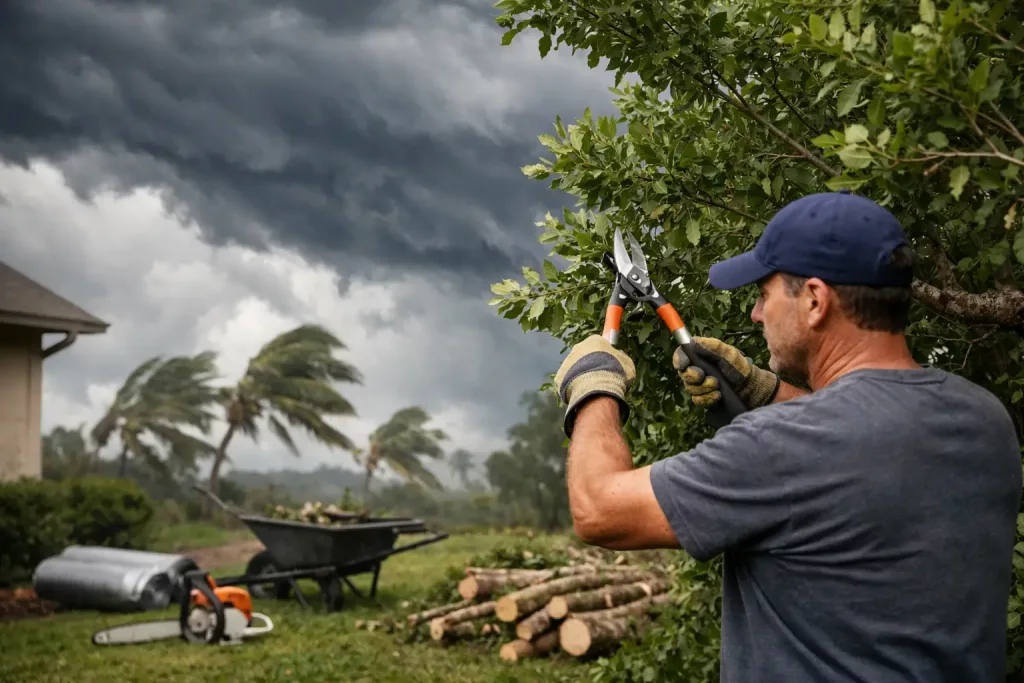
Most of the damage a tree suffers during a storm happens long before the first winds hit. A tree with a dense canopy, weak branch attachments, or root damage is already vulnerable. When a hurricane hits, the storm simply finishes the job that poor maintenance started.
For property owners in Central Florida, the question isn’t whether to prepare, but when. Time for hurricane tree prep is essential for home and commercial property protection. Get the timing wrong, and you might actually leave your trees more exposed to storm failure.
Table of Contents
- When is the best time for hurricane tree prep?
- Why early prep works better than last-minute trimming
- What hurricane tree prep should include
- Trees that deserve earlier attention
- The best time for hurricane tree prep depends on the work
- What not to do before hurricane season
- Timing around rain and saturated soil
- How homeowners and property managers should plan
- When to call a licensed tree service
- A better way to think about hurricane prep
When is the best time for hurricane tree prep?
Generally speaking, the ideal window is late winter through early spring. In Florida, tree care professionals usually target the months of January through April. This window is well past the threat of freezing temperatures (which can damage freshly pruned limbs) and comfortably ahead of the official start of hurricane season on June 1st.
This timing matters for a few reasons. First, trees are often dormant or experiencing slower growth in the winter, reducing the stress of pruning. Second, without the heavy canopy of spring and summer, it is much easier for an arborist to see the tree’s structure and identify weak branches, cracks, or crossing limbs that need removal.
There is some flexibility depending on the tree species, the size of the tree, and the condition of the canopy. But as a general rule, getting prep work done before the heat and rain of summer sets in is the smartest move.
Why early prep works better than last-minute trimming
It’s a common sight: a storm is named in the Gulf, and suddenly chainsaws are buzzing in every neighborhood.
But pruning trees just days before a hurricane hits is risky. Heavy pruning stimulates new growth, which can draw energy away from the root system right when the tree needs to hold on tight. More importantly, fresh pruning cuts are wounds. If a tree has to endure hurricane-force winds before those wounds have had time to compartmentalize (heal), it is more susceptible to disease and structural failure.
Early prep gives the tree time to adjust to its new canopy shape and heal its pruning cuts. Instead of being a panicked response to a weather alert, it becomes a proactive measure that strengthens the tree.
What hurricane tree prep should include
Good prep is not just about making the tree smaller. It is about making it more resilient.
The main goal is to reduce the “sail effect” of the canopy. A dense, thick canopy acts like a sail in high winds, catching the force of the storm and transferring it to the trunk and roots. Thinning the canopy allows wind to pass through more easily, reducing the stress on the entire tree structure.
A thorough prep job also includes removing dead, diseased, or broken limbs. These are the most likely to snap and become flying projectiles during a storm. An arborist will also look for “V-crotch” branches—narrow, weak unions between branches that are prone to splitting under pressure—and either remove them or install supportive cabling.
Structural pruning is also key. This involves shaping the tree to encourage a strong central leader (a dominant main trunk) and a balanced canopy. A well-balanced tree is much less likely to topple over when the ground gets saturated and the wind picks up.
Trees that deserve earlier attention
Not all trees respond to storms the same way. Some species are notorious for dropping limbs or failing entirely in high winds. In Central Florida, water oaks, laurel oaks, and fast-growing pines often require more frequent and careful attention. These trees tend to grow quickly but develop weaker wood and shallow root systems, making them higher risks during a hurricane.
Conversely, native species like live oaks and bald cypresses are generally much more wind-resistant, provided they have been maintained properly. Knowing what types of trees are on your property is the first step in prioritizing your prep work.
The best time for hurricane tree prep depends on the work
The type of pruning needed also dictates the timeline. Structural pruning and heavy thinning are best done during the dormant season (winter).
Routine maintenance and deadwood removal can generally be done year-round. If you spot a dead or hanging branch in July, you shouldn’t wait until January to remove it. That branch is an immediate hazard and should be taken care of right away.
Large-scale removals are a different story. If a tree is dead, severely diseased, or poses an imminent threat to a structure, it should be removed as soon as possible, regardless of the season. Leaving a hazardous tree standing during storm season is a massive liability.
The goal is to get ahead of the heavy lifting during the safer months, leaving only minor touch-ups or emergency hazard removals for the summer.
What not to do before hurricane season
The wrong type of pruning can be worse than no pruning at all.
“Hat-racking” or “topping” a tree is one of the most damaging practices. This involves arbitrarily cutting off the top of the canopy, leaving large, blunt cuts. While it might seem like a quick way to reduce the tree’s height, it actually ruins the tree’s structure and forces it to sprout weak, weakly attached shoots that are highly prone to breaking in future storms.
Over-lifting the canopy (removing all lower branches and leaving only a tuft of leaves at the top, like a broccoli stalk) is also dangerous. This makes the tree top-heavy and increases the risk of the trunk snapping or the entire tree uprooting in high winds.
Finally, never hire someone to “lion’s tail” your trees. This is the practice of stripping all the interior foliage and leaving leaves only at the ends of the branches. It makes the branches end-heavy, increasing the likelihood that they will snap.
Timing around rain and saturated soil
It is not just about the wind; the ground matters too.
When hurricanes hit, they often bring days of heavy rain. This rain saturates the soil, turning it soft and muddy. A tree’s roots rely on the friction of the soil to stay anchored. When the soil becomes overly saturated, it loses its grip on the roots, making the tree much more susceptible to uprooting, even in moderate winds.
This is another reason why a balanced canopy is so crucial. A top-heavy tree in saturated soil is a recipe for disaster. By properly thinning the canopy before the rainy season begins, you reduce the leverage the wind has on the root system.
How homeowners and property managers should plan
The best approach is to establish a regular schedule.
Property owners should have their trees assessed by a certified arborist every 1-3 years, depending on the age and species of the trees. This assessment will identify any developing problems and create a roadmap for maintenance.
The actual pruning work should be scheduled during the late winter or early spring window. Don’t wait for a storm to be named to start making phone calls. By the time a hurricane is in the Gulf, reputable tree services are fully booked, and you might be stuck with inexperienced workers who could do more harm than good.
Planning ahead not only protects your property but also saves you money. Emergency tree work after a storm is often significantly more expensive than proactive maintenance.
When to call a licensed tree service
Pruning small branches from the ground with pole saws is generally safe for homeowners. But anything that requires a ladder, a chainsaw, or working near power lines should be left to the professionals.
A licensed and insured tree care service has the equipment, training, and experience to work safely and efficiently. They also understand the biology of the tree and know how to make cuts that promote healing and structural integrity.
In Central Florida, companies like Tree Amigos Orlando have the local expertise to know which trees need what type of care and when. They can provide a comprehensive assessment and handle everything from routine pruning to complex removals.
A better way to think about hurricane prep
Preparing your trees for a hurricane is an investment in your property’s safety and value. It is not just another chore to check off the list; it is a critical step in defending your home against severe weather.
By understanding the timing, the techniques, and the importance of professional care, you can ensure that your trees are ready to weather the storm.