
Table of Contents
- Can dead trees fall suddenly even without a storm?
- Why dead trees become unstable so quickly
- Signs a dead tree may fall suddenly
- Can dead trees fall suddenly after rain?
- What property owners should do next
- When removal should not wait
- The bottom line on sudden tree failure
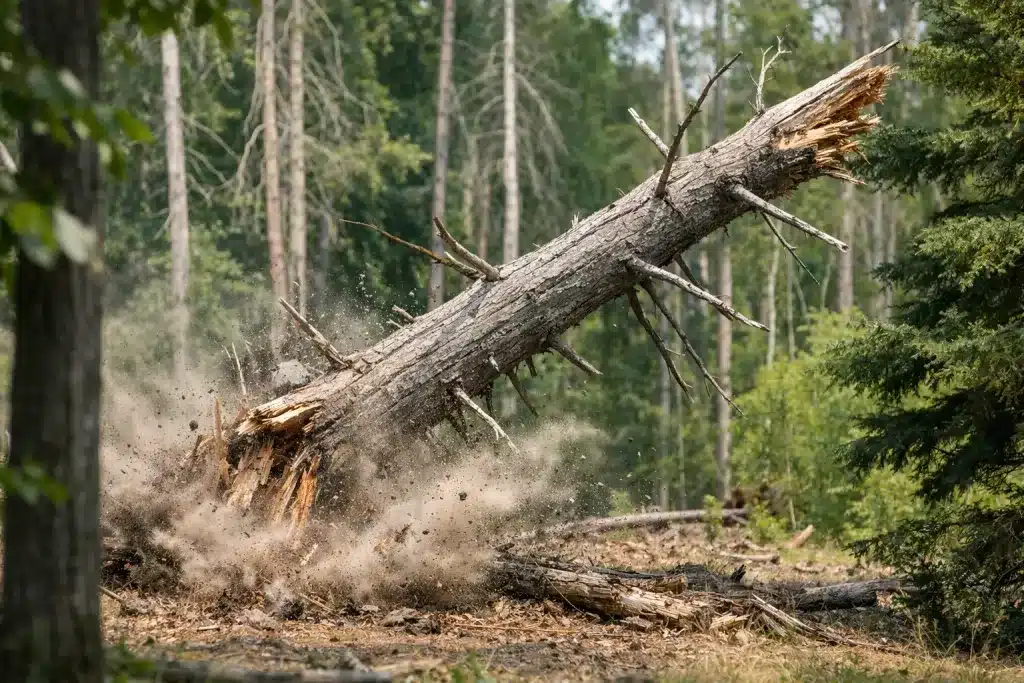
A dead tree can look stable right up until the moment it is not. If you are asking, can dead trees fall suddenly, the honest answer is yes – and in Central Florida, that risk often goes up fast after heavy rain, wind, or storm activity.
That is what makes dead trees so dangerous for homeowners and property managers. They do not always fall in a slow, obvious way. Sometimes the trunk gives out. Sometimes a major limb drops without warning. Sometimes the roots have already lost their hold and the whole tree shifts after a soaked week of rain. From the ground, the tree may look like it has been standing the same way for months. Internally, it may be far weaker than it appears.
Can dead trees fall suddenly even without a storm?
Yes. Wind is a major trigger, but it is not the only one. A dead tree can fall on a calm day if decay has weakened the trunk, hollowed out key structural wood, or damaged the root system below the surface.
This is one of the biggest misunderstandings property owners have. People often assume that if a dead tree survived the last storm, it is probably fine for a little longer. That is not a safe assumption. Dead wood does not recover. It only dries, more brittle, and more likely to fail over time. If fungi, insects, rot, or root damage are involved, the structure can keep deteriorating even when the weather is mild.
The risk also depends on the tree’s size, species, location, and how it died. A small dead ornamental tree in an open part of the yard is a different hazard than a large dead pine leaning over a roof, driveway, playground, or parking area. The second scenario leaves very little room for delay.
Why dead trees become unstable so quickly
A living tree still has moisture movement, active roots, and some ability to respond to stress. A dead tree has none of that. Once it dies, the natural process of breakdown begins.
In some cases, the outer shell stays standing while the interior wood softens. That can create a false sense of security. The tree still looks tall and upright, but the strength that once held it together is gone. In other cases, the roots start failing first. That is especially concerning after long wet periods, when saturated soil can reduce what little anchoring power remains.
Florida weather makes this worse. Strong thunderstorms, sudden gusts, tropical systems, and repeated rain events all put pressure on compromised trees. Even if the tree does not fully topple, it may shed large limbs first. That alone can cause major damage to vehicles, fencing, roofs, and walkways.
There is also a timing issue. Some trees stand dead for a while and then fail all at once. Others begin dropping branches early. There is no universal countdown, which is exactly why dead trees should not be treated casually.
Signs a dead tree may fall suddenly
Some warning signs are obvious, and others are easy to miss unless you know what to look for. If the tree has no leaves in the growing season, brittle branches throughout the canopy, peeling bark, visible cracks in the trunk, or fungal growth near the base, those are all reasons for concern.
Leaning is another important clue, especially if the lean appears new or more pronounced than before. Soil lifting around the root flare, exposed roots, or a gap forming in the ground on one side of the trunk can point to root failure. Cavities in the trunk matter too, but the real issue is not whether the hole looks dramatic. It is whether the remaining wood can still support the load.
Dead limbs hanging over a home, sidewalk, pool area, or commercial access point should be treated as a priority even if the main trunk is still standing. A branch failure can be just as dangerous as a whole tree collapse.
One caution here: not every risky tree looks dead from top to bottom. Some are partially dead, with one side of the canopy failing while the rest still produces leaves. That does not make the problem minor. Partial death can still signal structural weakness, disease, or root stress.
Can dead trees fall suddenly after rain?
Absolutely. Rain changes the equation in two ways. First, saturated soil can reduce root stability, especially if the roots are already decayed. Second, added moisture and wind pressure can expose hidden weaknesses that were not obvious during dry conditions.
This is common after back-to-back storms. A tree that stood through the first round may come down in the next one because the soil is softer, the roots are looser, and the wood has taken another hit. That is why post-storm inspections matter. Waiting until the next weather event is a gamble.
For commercial properties, HOAs, and multi-unit sites, this is also a liability issue. If a dead or clearly hazardous tree damages neighboring property or injures someone, questions about maintenance and response times usually follow.
What property owners should do next
If you suspect a tree is dead, stay clear of it and keep others away from the area. Do not park under it, let children play nearby, or try to cut large limbs yourself. Dead trees are unpredictable, and DIY removal is where many injuries happen.
A professional assessment is the right next step. An experienced tree crew can check canopy condition, trunk integrity, root stability, lean, defect patterns, and the likely failure zone. That matters because the answer is not always identical. Some trees need prompt removal. Some need immediate emergency attention because they are already splitting or shifting. Others may still be standing but are too close to structures to leave in place safely.
If the tree is near utility lines, that adds another layer of danger. Keep your distance and report the situation properly. Cutting or disturbing a dead tree around energized lines is not a homeowner job.
For larger properties, it also helps to think beyond the one obvious tree. Dead and declining trees often show up in clusters after disease pressure, lightning strikes, construction damage, soil compaction, or repeated storm stress. A broader inspection can catch the next problem before it turns urgent.
When removal should not wait
There are times when monitoring is no longer a reasonable plan. If a dead tree is leaning toward a structure, dropping large limbs, showing trunk cracks, lifting at the roots, or standing in a high-traffic area, waiting increases risk more than it saves money.
The same goes for trees close to homes, apartment buildings, entry drives, outdoor seating areas, and commercial parking lots. In those settings, the cost of delay can be much higher than the cost of professional removal. Property damage is one issue. Personal injury is another.
At Tree Amigos Orlando, we have seen how quickly a tree problem can shift from manageable to urgent after one stormy afternoon. That is why a dependable inspection and a clear plan matter.
The bottom line on sudden tree failure
Dead trees do not become safer with time. They become less predictable. Some stand longer than expected, and some fall much sooner than anyone thinks they will. That uncertainty is the real hazard.
If a dead tree is anywhere near something valuable or somewhere people spend time, treat it like a safety issue now, not a project for later. A timely inspection can give you a straight answer, and that peace of mind is worth far more than guessing from the ground.