A driveway is not just a path to your home; it’s a foundation that takes a beating. From heavy vehicles to shifting soil, the surface is constantly under stress. But one of the most common and frustrating enemies of a smooth driveway isn’t heavy equipment or bad weather—it’s the roots of the trees you planted for shade and curb appeal.
The slow, relentless pressure from growing tree roots can buckle concrete, crack asphalt, and create trip hazards that ruin your landscape and your property value. Finding the right tree roots damaging driveway solutions isn’t just about fixing the concrete; it’s about solving the problem at the source so it doesn’t happen again. The tension is obvious: save the tree, save the driveway, or find a way to compromise. Here is exactly how to navigate it.
Table of Contents
- Why tree roots damage driveways in the first place
- Start with the real question: save the tree, save the driveway, or both?
- Tree roots damaging driveway solutions that actually make sense
- What not to do when roots are lifting concrete or asphalt
- When the problem is minor versus urgent
- Why professional evaluation matters
- How to choose the right fix for your property
Why tree roots damage driveways in the first place
As trees grow, they don’t just reach up; they reach out. Tree roots typically grow outward, far beyond the drip line of the canopy, searching for moisture and nutrients. When a driveway is poured near a tree, it seals off the soil, trapping moisture beneath the surface. Roots naturally migrate toward that moisture, growing in the compacted soil directly under the driveway.
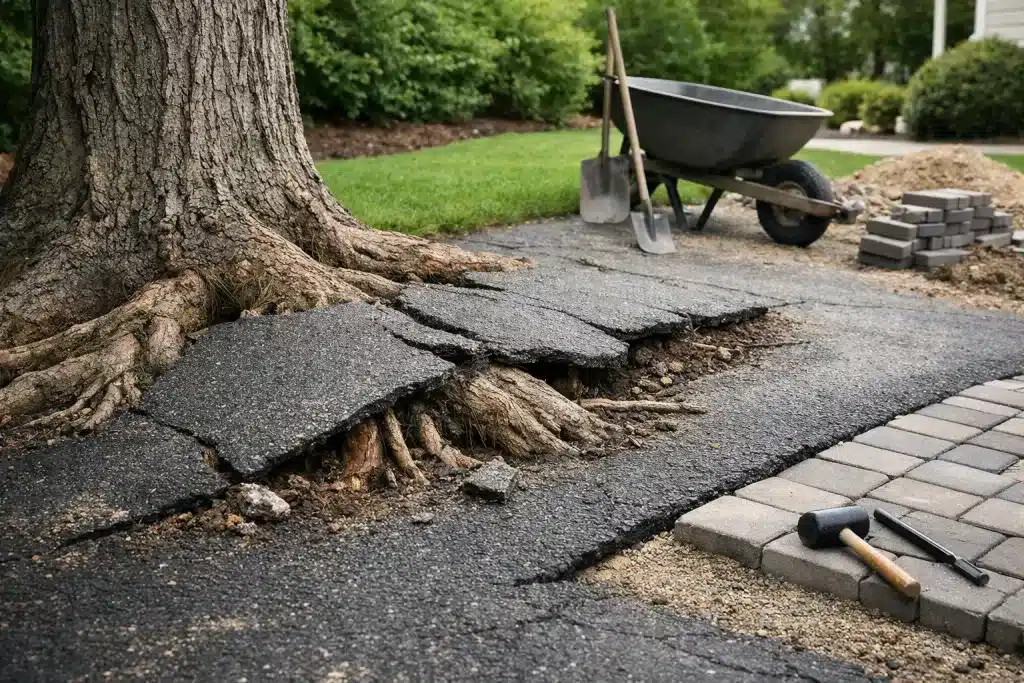
Over time, those roots thicken. As they expand in diameter, they exert incredible hydraulic pressure upward. Because concrete and asphalt lack the flexibility to absorb this pressure, they crack and heave.
The type of tree matters too. Species with shallow, aggressive root systems—like oaks, maples, and certain pines—are notorious for surface damage. A tree that was planted 15 feet away from the driveway ten years ago might suddenly become a problem today as its root system matures and expands.
Start with the real question: save the tree, save the driveway, or both?
Before ripping up concrete or firing up a chainsaw, property owners have to evaluate the tree’s health and value to the property. A large, mature oak provides shade, lowers cooling bills, and adds significant value. In that case, investing in careful mitigation might be the best path forward.
On the other hand, if the tree is diseased, structurally compromised, or simply a fast-growing, low-value species (like a water oak or camphor), spending thousands of dollars on complex driveway repairs doesn’t make sense. Removing the tree and starting over with a more suitable species might be the most cost-effective solution.
A professional assessment of both the tree and the driveway is crucial here. An arborist can evaluate the tree’s health, while a paving contractor can assess the driveway’s base. Sometimes, you can save both. Sometimes, you have to choose.
Tree roots damaging driveway solutions that actually make sense
There is no single fix for every property. The right solution depends on severity, tree condition, and budget.
Root pruning with caution
For minor lifting, root pruning might be an option. This involves carefully excavating the area and cutting the offending roots. However, this is a delicate process. Cutting the wrong roots can destabilize the tree, making it a fall hazard, or severely damage its health, leading to a slow decline.
Root pruning should always be done by or under the supervision of an arborist. The general rule is to never cut a root closer to the trunk than three times the trunk’s diameter. If a root is too close, or if multiple major support roots are involved, pruning is off the table, and other solutions must be considered.
Installing a root barrier
If root pruning is safely executed, the next step is often installing a root barrier. This is a physical or chemical barrier placed vertically in the soil to deflect future root growth downward and away from the driveway.
Root barriers work best when they are installed early in a tree’s life or after minor root pruning. They are not a guarantee, but they significantly reduce the chance of recurring damage. However, if they are installed incorrectly, they can trap water against the foundation or fail to stop determined roots.
Repairing or replacing the lifted driveway section
If the tree is staying and the roots cannot be safely pruned, the driveway itself must adapt. For minor cracks, patching and sealing might buy time. For more severe heaving, replacing the damaged section is necessary. When replacing the concrete, contractors may use reinforced rebar or a thicker pour to resist future lifting.
Another option is to replace the rigid concrete with a flexible material like asphalt or pavers in the affected area. Pavers can flex with root growth and can be easily lifted, reset, and leveled if the roots shift again.
Redesigning the driveway area
Sometimes the most effective solution is to give the tree the space it demands. This might involve altering the driveway’s footprint to curve around the tree’s critical root zone. While this requires a larger upfront investment, it offers a permanent solution that preserves both the tree and the driveway’s functionality.
This approach is increasingly popular in high-end residential communities where mature trees are highly valued and protected by local ordinances.
Tree removal when the damage keeps escalating
If a tree is too large, too close, or too aggressive, and the driveway damage is severe and recurring, removal may be the only practical solution. It is a tough decision, but continuing to pay for driveway repairs while the tree becomes a bigger liability isn’t sustainable.
If removal is the chosen path, stump grinding is mandatory. Leaving a large stump near a driveway guarantees that as it rots, the ground will settle, creating a new set of problems for the driveway’s base.
What not to do when roots are lifting concrete or asphalt
The biggest mistake is treating the symptom without addressing the cause. Grinding down a lifted concrete edge might fix the trip hazard for a few months, but the root will keep growing, and the concrete will lift again. It is a temporary band-aid on a permanent problem.
Another common mistake is aggressive, unguided root chopping. Homeowners often rent a concrete saw, slice out the broken section, and hack away at every root they see before pouring new concrete. This frequently kills the tree or, worse, makes it structurally unstable and likely to fall on the house during the next storm.
Finally, ignoring the problem is the most expensive mistake. A small crack today is a shattered slab tomorrow. Water enters the crack, washes away the base layer, and accelerates the destruction of the driveway.
When the problem is minor versus urgent
Minor heaving (less than a quarter-inch) or hairline cracks might just require monitoring and sealing to prevent water intrusion. In these cases, there is usually time to consult professionals and plan a long-term strategy.
Urgent situations arise when the heaving creates a significant trip hazard (usually a half-inch or more), when the cracking is extensive and the pieces are loose, or when the root damage is threatening the foundation of the house or garage, not just the driveway.
If the damage is severe, ignoring it is a liability risk. Delivery drivers, guests, or even family members can trip and fall, leading to expensive lawsuits. The faster you address a major trip hazard, the better you protect your property and yourself.
Why professional evaluation matters
A driveway contractor sees concrete; a tree service sees a tree. A homeowner dealing with this problem needs both perspectives to make an informed decision. One focuses on the integrity of the flatwork, and the other focuses on the biology of the plant.
This is why working with a company that understands both, or coordinating between an arborist and a paving contractor, is essential. They can determine the exact species of tree, evaluate its health, map its root zone, and recommend a repair strategy that balances the needs of both the landscape and the hardscape.
In places like Orlando, with strict tree ordinances and high water tables, professional guidance is not just helpful; it’s often legally required before you can remove a mature tree or make significant changes to the site.
How to choose the right fix for your property
There is no one-size-fits-all answer for tree roots damaging driveway solutions. The right fix depends on your budget, the tree’s value, and your long-term goals for the property.
If the tree is a cherished part of the landscape, redesigning the driveway or careful root pruning combined with flexible paving might be the best route. If the tree is a nuisance species causing constant headaches, removal is likely the smartest choice.
Budget is also a major factor. A quick patch is cheap but temporary. Root pruning and barrier installation are moderate. Driveway redesign or tree removal and replacement are expensive but offer permanent peace of mind.
The key is to act before a minor crack turns into a major excavation project. By understanding the solutions and working with experienced professionals, you can protect your driveway, manage your trees, and maintain the safety and beauty of your property.