Table of Contents
- Why tree decay is more than a cosmetic issue
- Top warning signs of tree decay to watch for
- When the signs are subtle
- What property owners should do next
- Why quick action matters after storms
- A practical rule for deciding when to call
A tree can look solid from the driveway and still be failing from the inside out. That is why missing the top warning signs of tree decay is a costly risk for property owners. By the time branches are dropping or a trunk snaps, the problem has usually been developing out of sight for years.
In Central Florida, where intense heat, heavy storms, and humidity are constant, tree decay can spread faster than it might in a cooler climate. The moisture accelerates fungal growth and rot, turning what seems like a sturdy oak or pine into a silent hazard.
Why tree decay is more than a cosmetic issue
Decay is the breakdown of wood by fungi and microorganisms. It eats away at the structural lignin and cellulose that give a tree its strength. When that support is compromised, the tree can no longer hold up its own weight, withstand storm winds, or carry a full canopy of leaves.
It is a structural failure waiting to happen. A healthy tree can flex in the wind; a decayed tree snaps. By the time tree decay is clearly visible, a lot of damage has already been done on the inside. That is why recognizing the early warning signs of tree decay is vital for protecting your home and landscape.
Top warning signs of tree decay to watch for
Mushrooms or fungal growth at the base
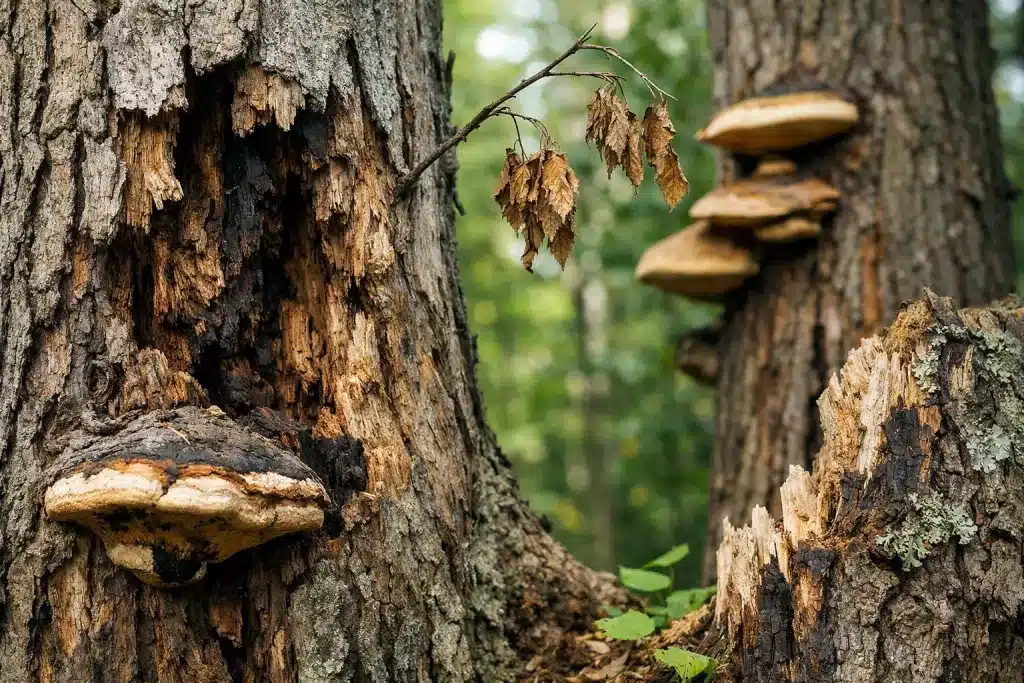
One of the clearest signs of internal decay is fungal growth on the trunk, root flare, or nearby soil. Conks, which look like shelf-like mushrooms attached to the bark, are a direct indicator that rot-causing fungi are active inside the tree.
These fungi feed on dead wood. If they are growing on a living tree, it means part of the tree is already dead and decaying inside. Certain types of fungi cause white rot or brown rot, both of which severely compromise the structural integrity of the wood.
Cavities and hollow areas in the trunk
Tree cavities are holes or missing sections of bark and wood. While some trees can live for years with a cavity, it is always a weak point. If a hole is large or located near the base of the trunk or a major crotch, it is a serious structural flaw.
A cavity provides easy access for moisture, insects, and more decay-causing fungi, speeding up the breakdown process.
Cracks, seams, and splitting wood
Deep vertical cracks, especially those that run deep into the wood or appear suddenly, point to structural failure. These cracks often happen because the wood is too weak to support the tree’s weight, causing it to split under stress.
This is particularly dangerous if a crack appears in the trunk or at a junction where a large branch attaches to the main trunk. That branch, or the entire tree, is at immediate risk of breaking.
Dead branches in the upper canopy
A few small dead twigs are normal, but if you notice large, dead, or leafless branches in the upper canopy during the growing season, it is a problem. This is often called “dieback” and suggests the tree’s root system or vascular system is failing to push nutrients and water up the trunk.
Dead branches, often called widow-makers, are a safety hazard themselves. If the decay continues, they can snap and fall without warning, endangering anything below.
Peeling or missing bark
Bark is a tree’s protective outer layer, much like our skin. If a tree is losing large sections of bark and not growing new bark in its place, it exposes the inner wood to the elements and pests.
Healthy trees shed bark as they grow, but they replace it. When bark falls off to reveal smooth, dead wood underneath, it often means that section of the tree is no longer viable and decay has likely started.
Soft, crumbly, or discolored wood
The wood inside a healthy tree is hard and solid. If you find spots on the trunk or branches where the wood feels soft, spongy, or crumbles easily in your hand, you are looking at advanced decay.
This is a common finding in old pruning cuts that did not heal properly, or where branches broke off jaggedly in past storms. Property owners should never probe these areas aggressively, but a visual check for soft, punky wood is a clear indicator of trouble.
Leaning that is new or getting worse
Some trees grow at an angle naturally to reach sunlight. However, if a tree suddenly starts leaning, or if a minor lean gets noticeably worse over a short period, it is a massive red flag.
Sudden leaning usually indicates root failure or significant structural decay at the base of the trunk. If you also see soil heaving or cracking on the opposite side of the lean, the roots are actively pulling out of the ground. The tree is structurally unstable and could fall at any time.
Root problems around the base
Tree decay is not limited to the parts you can easily see. Root rot is a major issue that can destabilize an entire tree without showing obvious signs on the trunk or canopy right away. Signs of root issues include fungal growth near the base (as mentioned), exposed roots that appear soft or dead, or a noticeable lack of root flare.
Because roots anchor the tree, severe root decay makes the tree highly susceptible to blowing over in a storm, even if the upper portions still look somewhat healthy.
When the signs are subtle
Sometimes, warning signs of tree decay are not obvious. The tree might have a full canopy of green leaves and look perfectly healthy from a distance. But up close, you might notice a small cluster of mushrooms hidden in the grass at the base, or a subtle crack forming near a crotch.
These subtle signs are easy to miss if you are not looking for them, which is why regular inspections are so important.
What property owners should do next
If you spot any of the warning signs of tree decay, do not ignore them. The longer you wait, the more dangerous the tree becomes, and the more complicated and expensive it will be to address the problem.
The first and most critical step is to have the tree evaluated by a qualified professional. An ISA Certified Arborist has the training and experience to properly assess the extent of the decay, evaluate the structural risk, and recommend the best course of action.
In some cases, if the decay is minor and isolated, the tree might be saved with proper pruning, cabling, or disease management. However, if the decay is advanced and the tree poses a significant risk to people or property, removal is usually the only safe option.
Never attempt to remove a large, decayed tree yourself. The wood is unpredictable and can behave erratically when cut, leading to severe injury or property damage. Professional tree services have the equipment and expertise to dismantle dangerous trees safely.
Why quick action matters after storms
Florida’s frequent thunderstorms and hurricanes put immense stress on trees. A tree with hidden decay might survive a mild season but fail catastrophically during a severe weather event.
The wind acts as a lever on the canopy, and if the structural integrity of the trunk or roots is compromised by decay, the tree will break. Proactive inspections and prompt removal of decayed trees before storm season hits can prevent disastrous property damage and protect your family.
A practical rule for deciding when to call
When it comes to tree care, a proactive approach is always better than a reactive one. If you notice any changes in a tree’s appearance, growth habits, or structural integrity, it is time to call a professional.
At Tree Amigos Orlando, we provide expert assessments and safe, reliable tree removal services to ensure your property remains safe and beautiful. Don’t wait for a decayed tree to become an emergency. Protect your property and gain peace of mind by addressing tree health issues as soon as they appear.