If you’re wondering whether that old oak or leaning pine needs to go, watching for the early signs a tree needs removal can save you from catastrophic damage. Here are 8 warning indicators to look out for on your property.
1. The tree is leaning more than it used to
While some trees naturally grow at a slight angle, a sudden or newly formed lean is a major red flag. This indicates structural instability or root failure.
Pay close attention if the lean is accompanied by cracked soil or exposed roots on the opposite side of the lean. This means the tree is actively uprooting and poses an immediate falling hazard.
2. Large dead branches keep appearing
If you constantly notice large, dead, or hanging branches (often called “widowmakers”), the tree is in decline. While occasional dead wood is normal, an abundance of it signals a deeper health issue.
Dead branches are unpredictable and can fall at any time, posing a severe risk to people and property below. If the crown of the tree is significantly dead, it is one of the clearest signs a tree needs removal.
3. The trunk has deep cracks, cavities, or decay
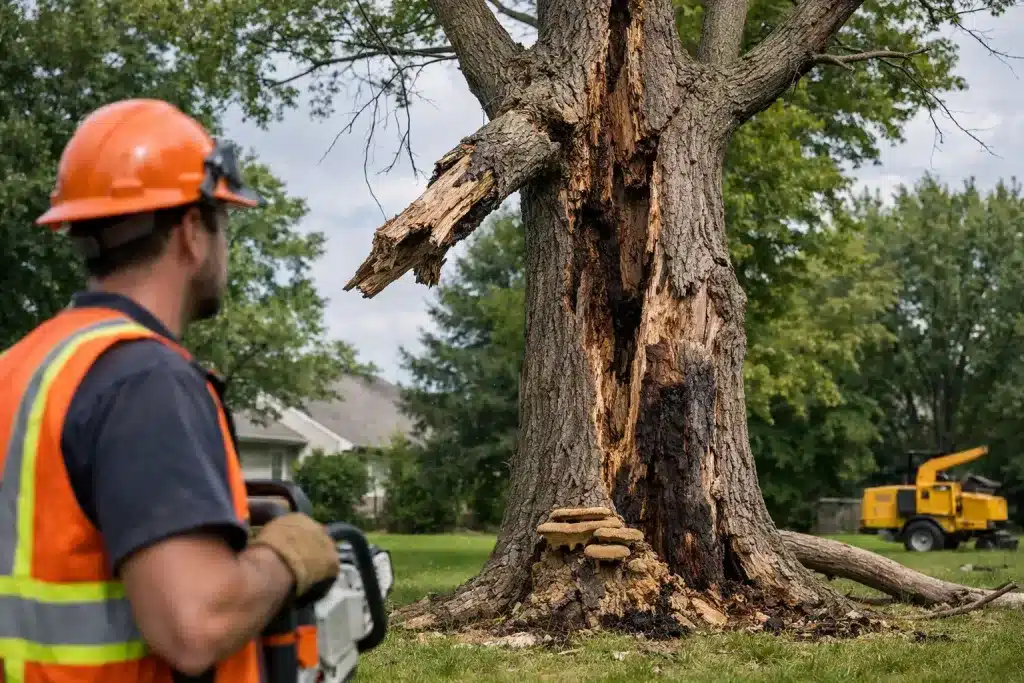
The trunk is the core support system of the tree. Deep structural cracks, missing bark, or large hollow cavities severely compromise the tree’s strength.
While some trees can live with minor cavities for years, advanced decay or splits that run through the trunk indicate that the structural integrity is failing, making the tree susceptible to breaking.
4. Mushrooms or fungal growth are showing up at the base
Fungi growing around the base of the trunk or directly on the roots are often a sign of internal rot. Mushrooms feed on dead organic matter, meaning the inside of your tree might be decaying even if the outside looks relatively intact.
Root rot and base decay weaken the very foundation of the tree, making it highly unstable. This type of aggressive decay is one of the definitive signs a tree needs removal.
5. The roots are damaged or the soil is lifting
Tree health isn’t always visible above ground. Root systems can be damaged by construction, excavation, disease, or extreme weather. Signs of root trouble include:
- Heaving soil: The ground lifting around the base of the tree.
- Fungus: Fungal growth explicitly on the root flares.
- Severed roots: Damage from nearby paving or digging.
6. The canopy is thin, bare, or declining unevenly
Healthy trees should have a robust, full canopy during their active growing season. If a tree has noticeably thinning leaves, bare branches, or is losing foliage entirely on one side, it is struggling.
Uneven decline can indicate root damage on one specific side or a localized disease that is spreading through the vascular system.
7. Storm damage has weakened the structure
Following severe Central Florida storms, high winds, or lightning strikes, a tree may sustain damage that is beyond repair. Even if it remains standing, structural twisting, split forks, or major canopy loss can make it a hazard.
If a storm has removed more than half of the tree’s crown, it is unlikely to recover. Assessing this post-storm canopy loss is critical, as severe twisting or splitting are common signs a tree needs removal.
8. The tree is too close to valuable targets
Sometimes a tree is perfectly healthy but grows too close to a house, power lines, or underground plumbing. As trees mature, their roots can damage foundations, while their branches can ruin roofs or create fire hazards.
If extensive pruning cannot safely clear the structure without ruining the tree’s health, taking it down is often the most practical long-term solution. Ignoring the signs a tree needs removal when it is threatening a home is a major liability.
When removal is the safer choice
Signs a tree needs removal versus pruning
Pruning is excellent for maintaining a tree’s health and shape, but it cannot fix severe structural failure, advanced internal decay, or root rot. If the core of the tree is compromised, pruning will only delay the inevitable.
It depends on species, age, and placement
Some tree species are naturally shorter-lived or more prone to splitting (like certain pines or water oaks). Fast-growing trees often have brittle wood. An arborist can help you determine if the specific species is worth saving or if its natural lifespan is ending. When assessing tree hazards, it is always recommended to consult a professional who follows the safety guidelines set by the International Society of Arboriculture (ISA).
What to do if you notice these warning signs
Tree removal is highly dangerous and should never be a DIY project. The erratic weight distribution of decaying wood requires professional rigging and equipment to bring down safely.
If you’ve spotted any of these 8 signs a tree needs removal on your property, the next step is to get a professional assessment. Tree Amigos Orlando provides expert tree evaluations. Our certified professionals can let you know definitively whether your tree can be saved with specialized care or if safe removal is required.