
- Emergency Tree Services, FAQ & Tree Advice, Orlando Tree Services
The 2026 Guide to Crane-Assisted Tree Removal in Orlando’s Tight Neighborhoods
Providing professional tree trimming and removal in Orlando, Florida, and surrounding areas.
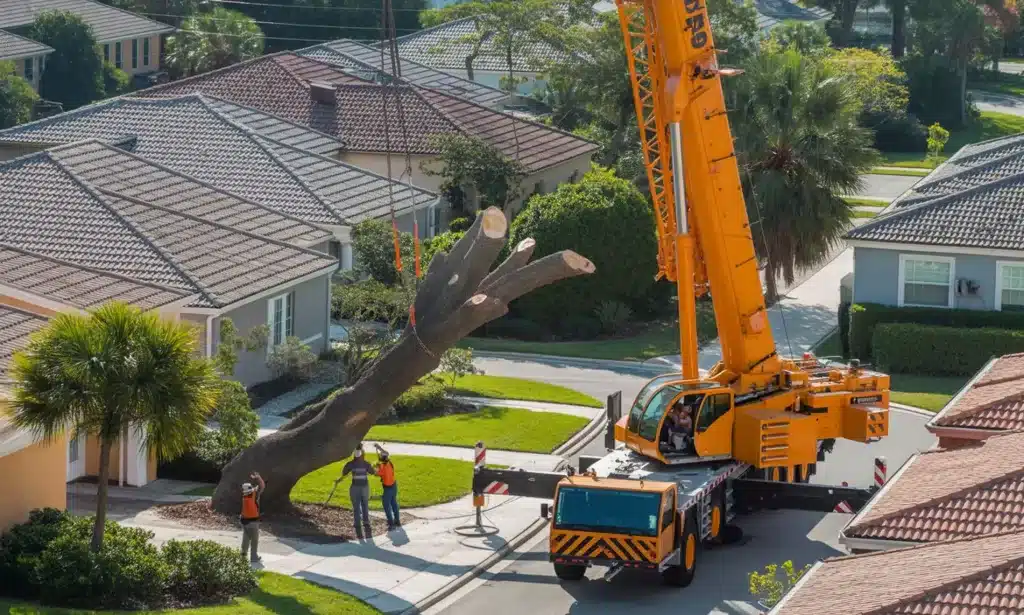
Table of Contents:
- The Unique Challenge: Massive Oaks in Historic Orlando
- What is Zero-Impact Crane Tree Removal?
- Key Benefits of Crane Tree Removal in Orlando
- Navigating Orlando Tree Removal Regulations in 2026
- When to Call in the Crane: Recognizing High-Risk Scenarios
- Conclusion: Protecting Your Property with Zero-Impact Methods
Orlando is known as “The City Beautiful” for a reason. Our streets are lined with towering, ancient live oaks that provide much-needed shade and historic charm. However, for homeowners in older neighborhoods like Thornton Park, College Park, and Lake Eola Heights, these majestic giants can quickly turn into complex liabilities. When a massive oak canopy looms directly over a historic roof with virtually no property line buffer, traditional tree removal methods simply aren’t safe.
The arboriculture industry has evolved rapidly, and by 2026, the integration of advanced lifting technology is no longer just a luxury—it is an absolute necessity for urban property management. This guide breaks down why leveraging heavy-duty cranes is the safest, most efficient, and often the only viable method for crane tree removal Orlando properties require, highlighting the critical importance of zero-impact tree removal 2026 protocols.

The Unique Challenge: Massive Oaks in Historic Orlando
Why Thornton Park and College Park Present High-Risk Scenarios
Older Orlando neighborhoods were developed long before modern zoning laws mandated generous setbacks. Homes are nestled close together, and the original landscaping has had decades—sometimes over a century—to mature. The live oaks (Quercus virginiana) dominating these areas can reach heights of 60 feet with canopy spreads of over 100 feet. When these trees become diseased, die, or sustain structural damage during Florida’s brutal hurricane season, removing them becomes a logistical nightmare.
Understanding the “Zero Drop Zone”
In a typical suburban setting, tree crews can cut large limbs and safely drop them into a spacious yard below. In tightly packed historic districts, this luxury does not exist. This is known in the industry as a “zero drop zone.” Directly below the canopy, you will find fragile historic roofs, delicate custom hardscaping, narrow driveways, and neighboring properties located just inches away. Dropping a multi-ton log is mathematically and safely impossible.
The Threat to Historic Roofs and Foundations
Historic homes in Central Florida often feature older structural elements that cannot withstand the shockwaves of heavy timber hitting the ground nearby, let alone a direct strike. A traditional removal attempt that miscalculates a drop zone could compromise a 1920s foundation or destroy an irreplaceable terracotta roof. This is where modern engineering and heavy machinery must step in.
What is Zero-Impact Crane Tree Removal?
The Mechanics of Crane-Assisted Dismantling
Crane-assisted removal completely flips the script on traditional tree cutting. Instead of cutting branches and letting gravity do the work, an ISA Certified Arborist is hoisted into the canopy to rig individual sections of the tree to a towering crane.
A successful crane operation is a symphony of expert communication. The crane operator and the aerial arborist communicate via specialized two-way radio headsets. They must calculate the precise green-weight of the timber being cut to ensure it doesn’t exceed the crane’s load chart for that specific boom angle and radius. All work must strictly adhere to ANSI Z133 safety standards for arboricultural operations and OSHA protocols. Once the section is securely strapped and balanced, the climber makes the cut. The crane then lifts the massive piece of timber up and away, floating it safely over roofs, power lines, and fences to a designated landing zone—usually the street—where a ground crew processes it immediately.
Traditional vs. Crane Removal Methods
Traditional removal relies heavily on complex rigging systems within the tree itself, which is time-consuming and inherently risky if the tree’s structural integrity is compromised. It also subjects the surrounding ground to heavy foot traffic and falling debris. Conversely, the zero-impact tree removal 2026 methodology utilizes cranes to completely bypass the yard. The tree is plucked piece by piece from the sky, ensuring that not a single branch touches your manicured lawn, expensive hardscaping, or historic home.

Key Benefits of Crane Tree Removal in Orlando
Unmatched Safety for Tight Space Tree Removal in Florida
Safety is the absolute priority when dealing with multi-ton organic structures in confined urban spaces. By employing a crane, the risk of unpredictable falls or rigging failures is virtually eliminated. The crane’s load capacity far exceeds the weight of the timber being lifted, providing a controlled, mathematically sound extraction. This protects the homeowner’s property, the neighbors’ properties, and the arborists performing the high-angle work.
Preservation of Landscaping and Hardscaping
Homeowners invest tens of thousands of dollars into their property’s curb appeal. Standard tree removal can wreck a lawn with heavy machinery tracks, dragging branches, and impact craters from falling wood. A crane operation is a true “zero-impact” solution. The crane parks on a solid surface (like a reinforced driveway or the street), and the tree is airlifted out. Your flowerbeds, irrigation systems, and custom pavers remain completely untouched.
Faster, More Efficient Operations
What might take a traditional tree crew three to four days of exhausting, high-risk labor can often be accomplished in a single day with a crane. This efficiency not only minimizes the disruption to your daily life and the neighborhood’s traffic flow but also reduces the total man-hours required on-site.
Navigating Orlando Tree Removal Regulations in 2026
The Protected Tree Standard and Grand Trees
The City of Orlando has strict ordinances protecting its urban canopy. As of the latest municipal regulations, any tree with a Diameter at Breast Height (DBH) of 10 inches or larger is considered a protected tree, requiring a formal Tree Removal Permit from the city’s Urban Forestry Division. For “Grand Trees” or “Historic Trees” (mature live oaks exceeding massive DBH thresholds), the burden of proof for removal is exceptionally high.
Historic Districts and the Certificate of Appropriateness (COA)
If your property is located in an officially designated Historic District—such as Lake Eola Heights or Thornton Park—you face an additional layer of municipal scrutiny. Any major exterior alteration, including the removal of a prominent tree, requires a Certificate of Appropriateness (COA) from the Historic Preservation Board.
Working with a company that understands both the operational complexities of tight space tree removal Florida regulations and the administrative hurdles of City Code is non-negotiable. They must provide an official Arborist Report proving the tree is a hazard to secure the necessary approvals. Additionally, the city enforces strict mitigation rules; removing a canopy tree often requires replanting new trees based on the removed caliper inches. For detailed municipal requirements, property owners should always reference the authoritative City of Orlando Tree Permit Guidelines.

When to Call in the Crane: Recognizing High-Risk Scenarios
Storm Damage and Hurricane Season Prep
Florida’s hurricane season is relentless. High winds can twist massive oak branches, leaving them fractured and hanging precariously (“widow-makers”). If a tree has been compromised by a storm, its internal structure may no longer support the weight of traditional climbing arborists. A crane allows the crew to dismantle the hazard without ever putting a climber’s weight on the unstable, storm-damaged tree.
Dead, Dying, or Diseased Giants
Trees suffering from root rot, fungal infections, or advanced decay are incredibly unpredictable. Because their wood is brittle and their root systems are weakened, they are highly susceptible to sudden collapse. In these scenarios, arborists rely on cranes to safely extract the decaying mass before gravity takes a devastating toll on the structures below.
Foundation and Plumbing Threats
It isn’t just the canopy that poses a threat; the root systems of these massive oaks can be equally destructive. In historic neighborhoods, root systems aggressively seek out moisture, often infiltrating and destroying 1920s terracotta sewer lines or cracking historic brick foundations. When roots compromise the structural integrity of the home itself, removal becomes an urgent necessity. Because the tree is located so close to the foundation it is destroying, crane extraction is the only way to remove the trunk safely.
Conclusion: Protecting Your Property with Zero-Impact Methods
Removing a massive tree in an older, densely populated neighborhood is not a DIY project, nor is it a job for an under-equipped landscaping crew. The unique constraints of Orlando’s historic districts demand specialized engineering, meticulous planning, and profound arboricultural expertise. By embracing the principles of zero-impact tree removal 2026, homeowners can eliminate hazardous trees safely and efficiently, preserving the integrity of their historic homes and the beauty of their surrounding landscapes. If you have a looming giant threatening your tight-space property, it’s time to look to the sky for the solution.

Posted on Google
 Jasper
Trustindex verifies that the original source of the review is Google.
First this tree is completely on my neighbor's side these guys did a great job at clearing the overgrowth over my property and over my house quite a job this was a high up reach and completely cleared my airspace from the overgrowth of the tree, it was a danger to walk into my backyard as tree was getting old and big branches were falling some widowmakers were there you know what I mean( I feel safe going into my yard now) Three amigos you guys did an exceptional job thank you so much.Posted on Google Michael BrauchNick and the crew at Tree Amigos were fantastic. Great pricing, timing, crew, etc. We had a 50-60ft tree in our backyard that needed to be removed and other large trees to be trimmed. They were able to get us on the schedule quickly and left the yard in great condition. Highly recommend!Posted on Google
 juan canoBest price in town, great service, great consideration of neighbors during removal of huge oak treesPosted on Google
 Ryan JepsonThese guys killed it. I had an annoying, big, complicated landscape removal project. Huge trees to remove, overgrown jungle to remove, dozens of stumps to grind. They had a fair price and did a great job. Super happy with the outcome.Posted on Google
 Alton CumberbatchNick, from Tree Amigos Orlando, came by and discussed my trimming needs. His quick scheduling and execution improved the presentation of my front yard immeasurably. Nick, please accept my appreciation for your superior work. Thanks a bunch:to you and your crew! Alton.Posted on Google
 Liliana TaylorVery quick turnaround from quote to service and did a very thorough job cleaning up after!Posted on Google
 Kevin HallI did not have work done by this company, but my neighbor did and I can tell you they did an exceptional job. Not only were they fast and efficient. They took the courtesy of getting any debris out of my yard as well, which is unheard of nowadays. The guys were very friendly and I would definitely recommend them.Posted on Google
 BIG MAFriendly and courteous! Completed two large tree removals in great time. Total clean up of area. 😎😅Posted on Google
 Barb AllenGood price for two tree removal. Friendly workers. Total clean up of area.Posted on Google
 Manuel Rodrigues100% recommend Tree Amigos! They did a great job trimming all the trees around my house. They definitely know what they’re doing. Fair price, showed up on time, very respectful, and left everything clean. A good old school company that does quality work at a reasonable price. Great experience and I’ll definitely use them again!Load more