
- FAQ & Tree Advice
My Neighbor's Tree is Hanging Over My Fence: What Are My Rights in Florida?
Providing professional tree trimming and removal in Orlando, Florida, and surrounding areas.
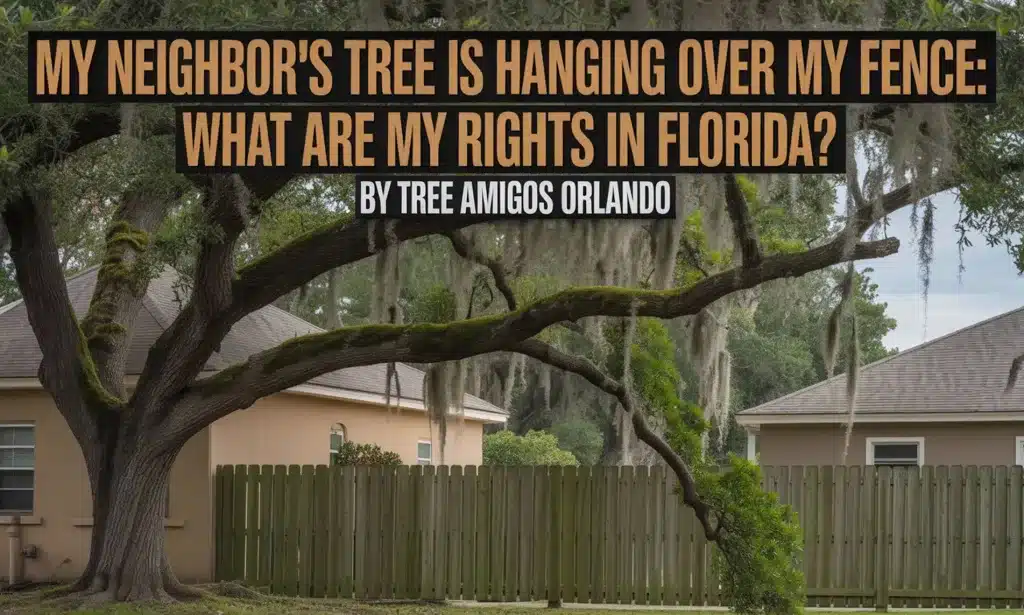
Table of Contents:
If you own a home in Orlando or the surrounding Central Florida area, you’ve likely stared at a massive Live Oak or sprawling Camphor tree branch extending well past your fence line, dropping leaves into your pool or threatening your roof. It is one of the most common questions our team at Tree Amigos Orlando hears: “Can I cut these branches without asking my neighbor?”
The short answer is usually yes—but with a massive “however” attached to it.
Navigating property lines, tree health, and neighborly relations can be tricky. In Florida, the laws regarding encroaching vegetation are distinct, and mishandling the situation can land you in legal hot water or leave you with a hefty bill for replacing a damaged tree.
In this guide, we will break down your rights as a homeowner, the risks of “vigilante pruning,” and how to handle encroaching trees the right way.
(Disclaimer: We are certified arborists, not attorneys. This information is based on general Florida property standards and arboricultural best practices. For specific legal disputes, always consult a qualified real estate attorney.)
The “Self-Help” Rule: Understanding Your Property Rights
Under Florida common law, property owners generally have the right to trim branches and roots that encroach onto their property. This is often referred to as the “self-help” remedy. Essentially, your property line extends vertically from the ground up to the sky.
If your neighbor’s tree limbs cross that invisible vertical plane, they are technically trespassing in your air rights. You are typically within your rights to trim those branches back to the property line, provided you stay on your side of the fence.
However, this right is not absolute. There are three critical limitations you must respect:
- Do Not Trespass: You cannot enter your neighbor’s property to trim the tree without their permission. Even leaning a ladder against the tree trunk on their side constitutes trespassing.
- Do Not Kill the Tree: This is the most vital rule. Florida law does not permit you to inflict “irreparable harm” on the tree. If your trimming causes the tree to die or become structurally unstable, you could be liable for damages—which, for mature trees in Orlando, can run into the thousands of dollars.
- Do Not Create a Hazard: If you prune a tree incorrectly (for example, leaving it unbalanced), and it later falls and causes damage, you could be held responsible.
The Danger of “Hat-Racking” and Improper Cuts
Just because you can cut a branch at the property line doesn’t mean you should just hack it off exactly at the fence.
Trees don’t understand property lines. Cutting a branch at an arbitrary point (the fence line) often results in a “stub cut.” Stub cuts prevent the tree from sealing the wound properly, leading to decay, pest infestation, and disease entry.
Furthermore, removing too much foliage at once (known as “lion-tailing” or “hat-racking”) puts the tree into shock. According to the University of Florida IFAS Extension, improper pruning is a leading cause of tree failure during storms.
If you hack off 40% of a neighbor’s tree canopy simply because it was over your fence, and that tree dies a year later, the neighbor may have a strong legal case against you for the replacement value of that tree. This is why hiring a professional tree trimming service is essential. A certified arborist knows how to make “reduction cuts” to a lateral branch, which might mean cutting slightly less or slightly more than the exact property line to ensure the tree remains healthy and you remain liability-free.
Who is Responsible if a Neighbor’s Tree Falls on My House?
This is the second most common question we receive, especially during hurricane season.
In Florida, liability for falling trees generally depends on the health of the tree before it fell.
- The Healthy Tree (Act of God): If your neighbor’s tree was healthy, well-maintained, and lush, but a massive storm like a hurricane knocks it onto your roof, this is typically considered an “Act of God.” In this scenario, your neighbor is usually not liable. You would file a claim with your own homeowner’s insurance policy to cover the damage.
- The Dead or Diseased Tree (Negligence): If the tree was obviously dead, decaying, or dangerous (a “hazard tree”), and the neighbor knew (or should have known) about it but failed to remove it, they could be found negligent. In this case, their insurance might be responsible for your damages.
This distinction highlights why it is so important to document the condition of trees near your property. If you suspect a neighbor’s tree is dangerous, we recommend sending a certified letter requesting they address the hazard. This creates a paper trail regarding their knowledge of the issue. For immediate concerns, our emergency tree services can help assess the risk.
Protected Trees in Orlando and Central Florida
Before you start sawing, you must also consider local ordinances. Many municipalities in Central Florida, including the City of Orlando and Orange County, have strict tree protection rules.
“Grand Trees” or “Specimen Trees” (often large Live Oaks or Cypress trees) are protected by law. Even if a Grand Tree’s branches are over your property, aggressive pruning that damages the tree’s health could violate city codes, resulting in fines.
Always check if the tree in question requires a permit for significant alteration. As a professional tree service, Tree Amigos Orlando handles all necessary permitting and compliance checks before we begin work, ensuring you don’t accidentally violate an environmental ordinance.
The Best Approach: Communication and Professional Help
Disputes over trees can turn friendly neighbors into enemies overnight. Before you take out the pole saw, follow these steps:
- Talk to Your Neighbor: Knock on their door. Explain that the branches are dropping debris on your car or rubbing against your roof. Most neighbors are reasonable and may even offer to split the cost of professional trimming.
- Hire a Certified Arborist: Don’t rely on a handyman or a DIY approach for boundary trees. A licensed professional can determine exactly how much can be safely removed without harming the tree.
- Focus on Structural Pruning: Instead of just chopping everything at the line, ask us about crown reduction or directional pruning. These techniques encourage the tree to grow away from your structure naturally over time.
Why Choose Tree Amigos Orlando?
When dealing with boundary disputes, you need a service that is precise, insured, and knowledgeable about local laws. At Tree Amigos Orlando, we specialize in residential tree trimming that respects both your property rights and the biology of the tree.
We use ANSI A300 pruning standards to ensure that when we trim back encroaching limbs, we leave the tree healthy and structurally sound. This protects you from liability claims and ensures your yard remains safe and beautiful.
Don’t let a stray branch ruin your relationship with your neighbor or your home’s foundation. Contact us today for a consultation, and let’s reclaim your yard the right way.
Posted on Google
 Jenny Lake
Trustindex verifies that the original source of the review is Google.
I have used Tree Amigos two times. They gave me a quote and came quickly to do the job. They were very professional and kind and did superb work! I would definitely recommend them and will use them again for tree trimming maintenance.Posted on Google Dennis EickelmanI have used them in the past, they lived up to my previous experience with them. Easy to work with and very efficient. Will definitely use them again in the future.Posted on Google
 John ConcannonWe had 4 tall pine trees removed by the Tree Amigos team led by Luis and they performed over and above what was promised. Highly recommended especially for difficult tree removal jobs.Posted on Google
 Mary BywaterLuis and his crew did a great job. I’m very pleased.Posted on Google
 Glenda MorganI have used Tree Amigos many times and always had a positive experience. Recently had a huge tree taken down in my backyard and couldn’t be more pleased with their work!Posted on Google
 Bob ZiegenfussTree Amigos is always fast and very fair priced.Posted on Google
 Jared CLuis was super responsive and provided a fair price. They were able to grind two stumps by the next business day and were understanding of the needs on site.Posted on Google
 Hiren ShahI have had Tree Amigos help with tree trimming and sod replacement. Great team with great service.Load more